
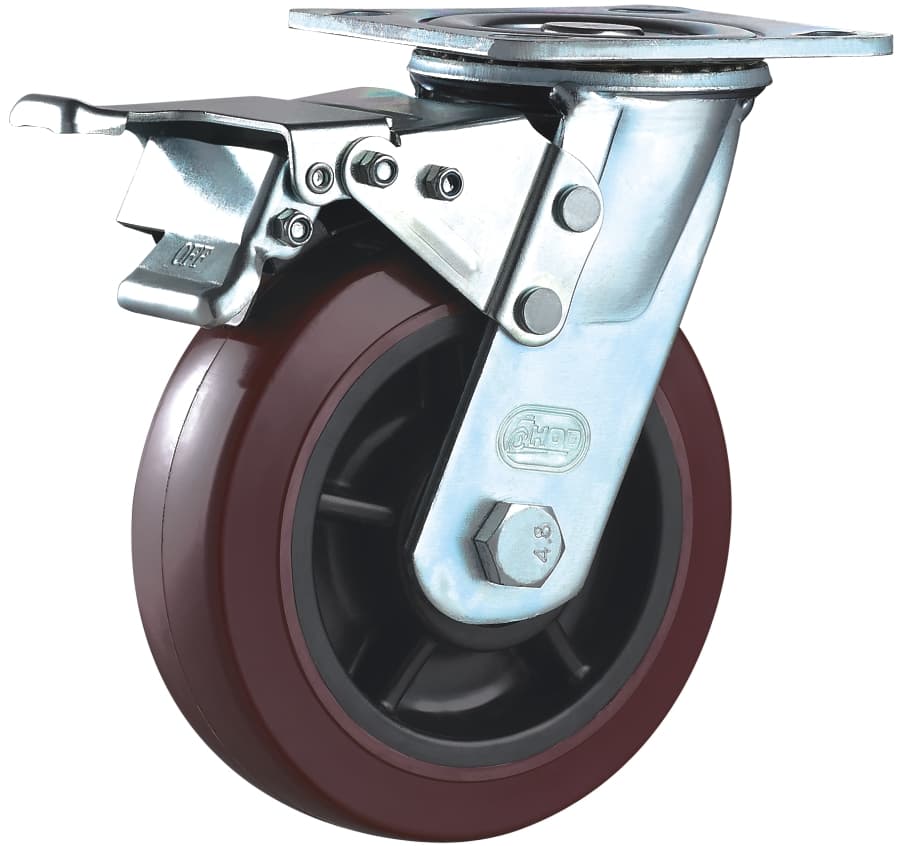
This guide is for buyers who order casters for trolleys, racks and equipment. It shows you how to turn the weight of your equipment into a load per caster. Then you can ask us for a quote with the right figures, and order the right caster the first time.
Start with the loaded weight
Weigh the empty trolley. Then add the heaviest load it will ever carry. Write both figures down with their units.
Do not order by total equipment weight alone. A payload figure does not include the weight of the trolley itself. The caster must carry both.
Check what a catalogue figure describes. It may be for one wheel, one complete caster or the whole trolley. A rating for one caster is not the rating for a trolley.
Work out the load per caster
Divide the total weight by the number of casters. A trolley with four casters gives each caster one quarter of the weight. That is the starting figure you compare with the catalogue.
The real load is often uneven. A load that sits to one side puts more on two casters. A trolley that stops against a joint in the floor puts a sudden load on the front ones.
So do not stop at the simple sum. Tell us how the load sits and how the trolley moves. We will help you decide how much margin you need.
See how the catalogue states load
Our catalogue gives a load range for each series. Each range is per caster. The wheel material and the model inside the series change the figure.
Our heavy duty series is listed at 120 to 505 kg per caster, depending on the wheel. It lists double bearing wheels in YUPA, PU, Iron Core PU, PA, ER and TPR. Each wheel is listed as a swivel top plate caster, a swivel top plate caster with brake and a rigid top plate caster.
Read the load on the exact model, not only the series range. Two casters in the same series can carry very different loads.
When the load is very high
Some equipment is far heavier than a normal trolley. Then you need to look past the heavy duty series.
Our extra heavy duty series is listed at 2000 to 4000 kg per caster. It is the HOD 92 series with PA wheels and double bearing. It comes as a swivel top plate caster and a rigid top plate caster.
The catalogue lists no brake version for this series. If you need a brake, tell us and we will check what we can offer.
Tell us how it will move
Two trolleys with the same weight can need different casters. The way you use the trolley changes the job. Tell us:
- whether people push it by hand or a vehicle tows it, and how fast it goes;
- what the floor is made of, and whether it has joints, ramps or thresholds;
- whether the floor is wet, or whether chemicals or heat are present;
- whether the load is steady or can shift;
- whether you need a brake, and on which casters.
Tell us if the floor is wet or chemicals are used, and we will confirm the wheel material. Tell us about any slope too, and we will help you decide how many brakes you need.
Compare an exact model
Use the caster finder to narrow the range. Then pick the exact model and note its product code. Keep the code with your equipment records.
Write down the series, the wheel material and the mounting. Casters fix with a top plate, a threaded stem, a bolt hole or another fitting. A swivel caster turns to steer. A rigid caster goes in a straight line. A brake version can lock the wheel, the swivel or both.
Treat the finder result as a shortlist. Your floor, your cleaning and your load may differ from what the catalogue assumes. Send us the shortlist and we will confirm the right series.
What to send us for a quote
- The weight of the empty equipment and the heaviest load, with units.
- The number of casters and how they are arranged.
- Pushed by hand or towed, and the speed.
- The floor type, and any joints, ramps, water, chemicals or heat.
- The product code on your current casters, if you have it.
- The mounting: top plate, threaded stem, bolt hole or another fitting.
- The overall height you can fit.
- Fixed, swivel or brake, and how many of each.
- The quantity you need.
Request a quote on our website or message us on WhatsApp, and we will confirm the right series for your load.