
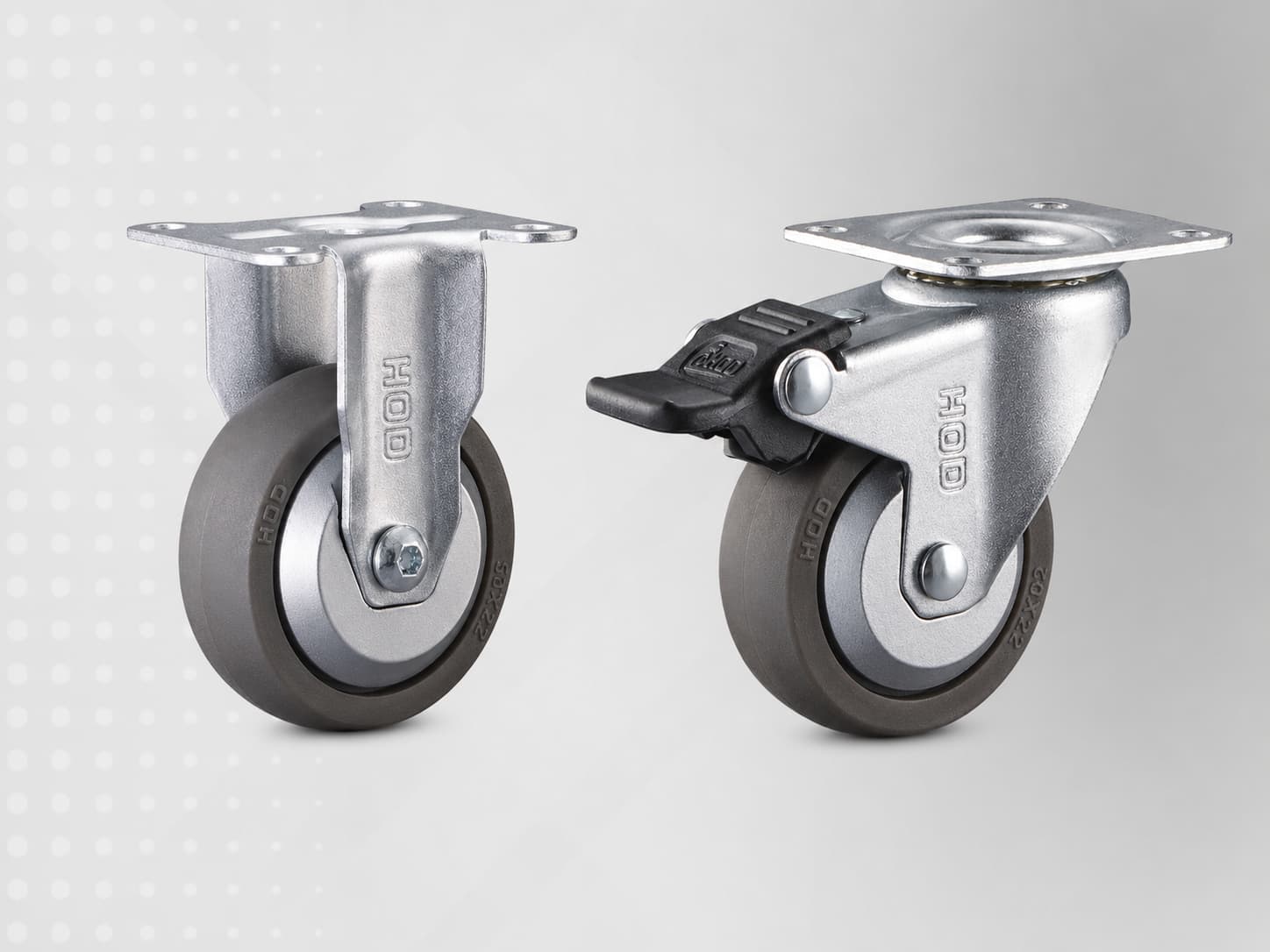
This guide is for buyers who need to choose or change a caster wheel material. It helps you describe the job, so we can confirm the right material. A wrong wheel means marked floors, noisy trolleys and a second order.
Describe the problem, not the colour
Start with what the current wheel does badly. You may have noise on one floor, black marks, a trolley that is hard to push or a wheel that wears out too early. Write it down in plain words, and note which trolley and which floor it happens on.
Separate what you saw from what you assume. "The wheel leaves a black mark on our white tile" is a useful observation. "We need a white wheel" is a guess. A colour does not tell us the material.
Wheel material changes noise, floor marking and wear. Tell us your floor and we will suggest a material.
Know the materials we list
Our catalogue lists wheels in PU, PA, nylon, TPR and other materials. Each series lists its own options. The same material name can appear in several series, so the series matters as much as the name.
Our heavy duty series lists YUPA, PU, Iron Core PU, PA, ER and TPR wheels. The load is listed per wheel group, so a change of material can change the rating.
Do not assume one material from the name of another. Ask us for the exact wheel in the exact series. Then compare it against your checklist.
Wet floors and stainless steel
Wet floors and cleaning chemicals affect which wheel and bracket material you need. Tell us how you clean: wipe, wash or hose down. Also tell us which products you use, and how often.
Our stainless steel casters are listed with SUS 304 or 316L frames. Our catalogue describes the S-Series stainless caster as corrosion-immune and ideal for medical equipment and chemical labs. It lists TPR or pure nylon core wheels.
The wheel and the bracket work together. Tell us the conditions, and we will check that the bracket and wheel suit them.
Heat
Not every wheel suits heat. Tell us the hottest point on the route and how long the caster stays there.
Our high-temperature series is listed without a temperature rating. So ask us to confirm it for your job. Do not choose a wheel from the words "high temperature" alone.
Heat can affect the bearing as well as the wheel. Give us the whole picture: the temperature, the time, the floor and how often the trolley goes through the hot area. Then we can check the series against your route.
Static control
Our conductive series is listed with conductive TPR wheels. If your work needs a conductive path, ask us for the product documents. Ask your quality team what your site needs from trolley wheels.
Fit the whole trolley from the same series.
Test before you order in quantity
For a new material, try one or two casters on the real equipment first. Your floor, cleaning process and load may differ from what the catalogue assumes. A short trial shows problems that a list of figures cannot. It also costs less than a full order of the wrong wheel.
Agree in advance what you will look at. Check for marks on the floor, noise, how easy the trolley is to push and how the wheel looks after cleaning.
Write down the model, the date and what you saw. That note becomes the reference for your next order. When we offer an alternative, compare it with your checklist, including the load rating and the wheel material.
What to send us for a quote
- The current wheel material, if you know it, and what works or does not.
- The floor type and condition: smooth, rough, coated, wet or dry.
- Pushed by hand or towed, and the speed.
- The cleaning products you use and how often you clean.
- The temperature range and any chemicals, water, oil or sun.
- The mounting: top plate, threaded stem, bolt hole or another fitting.
- The load per caster and the number of casters.
- The product code of the current caster, if you have it.
Use the caster finder to start a shortlist. Then request a quote on our website or message us on WhatsApp, and we will confirm the right series.