
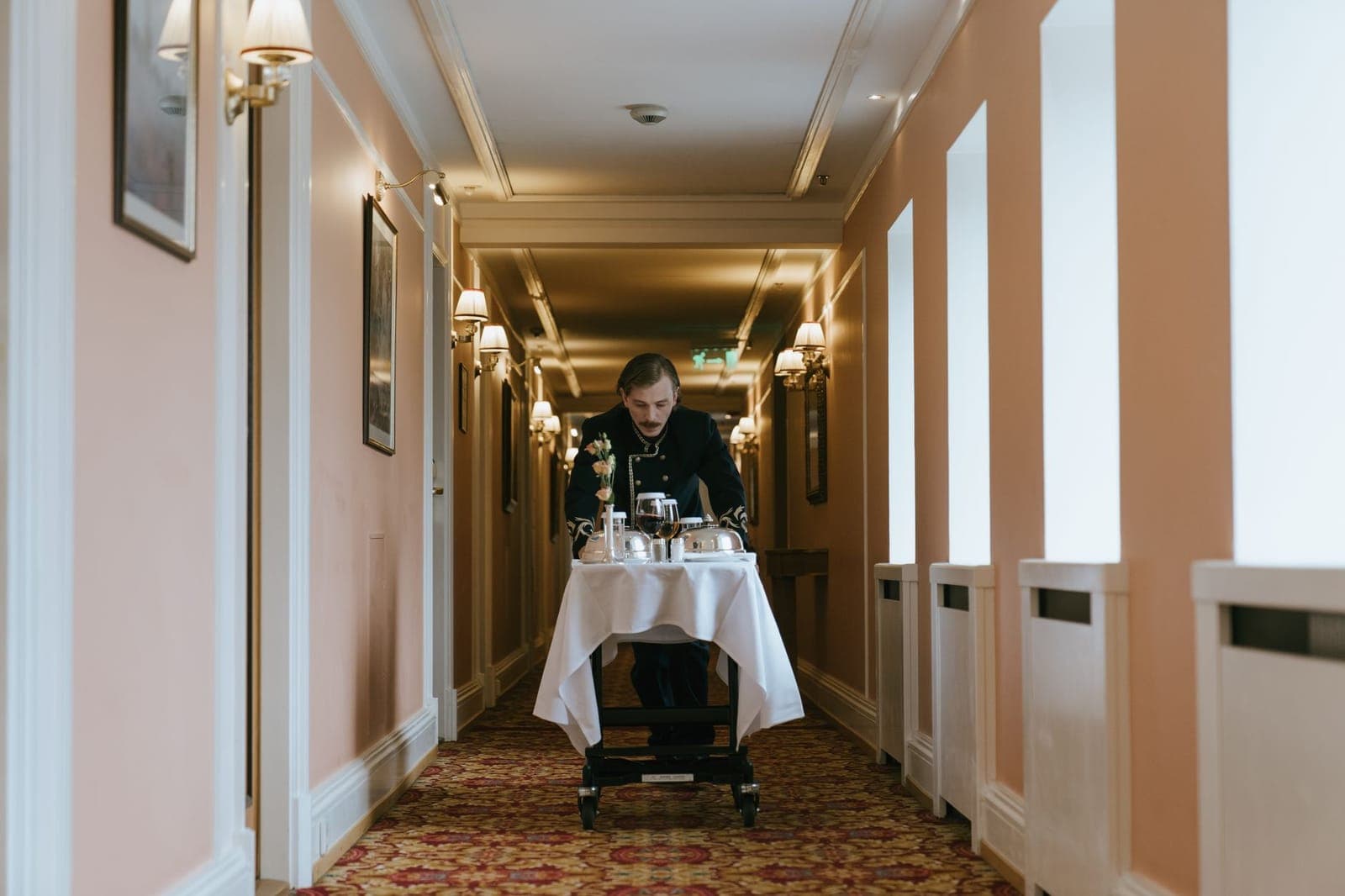
This guide is for catering managers, airline and airport service teams and fleet buyers who order casters for service carts and food trolleys. These trolleys are loaded full, pushed far and cleaned often. A wrong caster means a stopped trolley and a late service.
Map the trolley's route
Write down every surface the trolley meets in one shift. A catering trolley may cross a kitchen floor, a loading dock, a ramp, a lift and a terminal corridor. Each place treats a wheel differently.
Note the gaps and thresholds too. Lift gaps, door strips and ramp edges stop small wheels. Wheel material affects noise and floor marks, so tell us about floors where passengers or guests are present.
Then note how often the trolley moves. A cart on a long daily route works harder than one that stands in a store room. Tell us the length of the route and the number of trips in a shift.
If some trolleys travel outdoors, for example across an apron or a loading area, tell us that too. Rough ground and wet ground both affect the choice of wheel.
Heavy duty series
A full catering trolley is heavy, and one person often pushes it. Count the frame, the trays, the containers, the drinks and the food. Divide the total by the number of casters, then leave margin.
Our heavy duty series is the HOD 72 and 73 range, listed at 120 to 505 kg per caster depending on the wheel. It comes as a swivel top plate caster, a swivel top plate caster with brake or a rigid top plate caster. See the heavy duty page for the wheel options.
The wheel material you pick changes the rating, so send us the weight and we will confirm the right option.
Universal trolleys
Fleet buyers often start from the trolley they already run. If you have a trolley code or a data plate, send it with your enquiry.
Our catalogue lists universal trolleys at 150 to 200 kg, in seven models: TC-300W, TC-150, TC-300, TC-150S2, TC-300S2, TC-150S3 and TC-300S3.
Our catalogue does not list a use for these models, so tell us what your trolley carries and how it is built. We will confirm whether a universal trolley model is the right choice or whether another series is better.
Brakes, cleaning and fleet matching
Tell us which casters on each trolley need a brake. If the trolley works on a ramp or a sloped floor, say so in your enquiry.
Food service trolleys are cleaned often. Wet floors and cleaning chemicals affect which wheel and bracket material you need. Tell us how you clean, and we will say if a stainless steel series is worth quoting.
Airport and catering fleets often have many trolleys of the same type. Fit all casters on a trolley from the same series and wheel material, so they wear alike. Send us the code of the caster you use now.
Look at the wheels on a few trolleys at regular times and tell us what you see. Order before the trolleys stop, and tell us how many trolleys you run.
Check the mounting
A caster that does not fit the frame is a wasted order. Compare the old caster with the frame before you request a quote.
Look at how the old caster fits: top plate, threaded stem, bolt hole or another fitting. Keep an old caster as a sample when you can. A photo and a few measurements save time on the quote.
Our caster finder filters by mounting type and load. It is a good first step when you do not know the series.
What to send us for a quote
- What the trolley is, what it carries and how many you run.
- Total loaded weight and the number of casters.
- The route: floors, ramps, lifts, thresholds and outdoor stretches.
- How you clean: wipe, wash or hose down, and which chemicals.
- Mounting type, with a photo or measurements of the old caster.
- Fixed, swivel or brake, and how many of each.
- The code of the caster you use now, if you have it.
- The quantity you need.
Request a quote on our website or message us on WhatsApp, and we will confirm the right series for your conditions.