
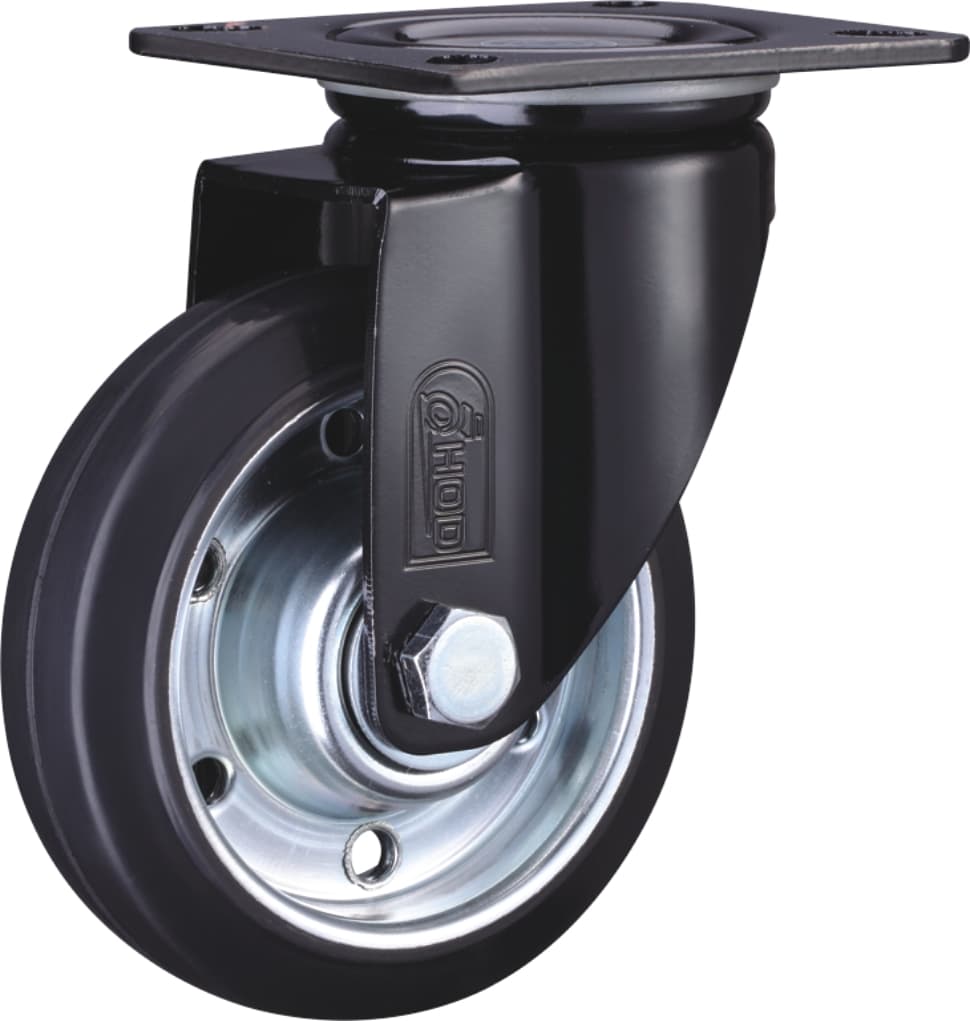
This guide is for production managers, line supervisors and maintenance teams who buy casters for carts that move parts between work cells. A cart that rolls badly slows the people who push it, and a wrong caster means a second order. Here is how to prepare an enquiry so we can confirm the series.
Map the cart route and weigh the load
Walk the route the cart takes from one work cell to the next. Note where it starts, where it stops and where it turns. Note the floor changes on the way: a painted floor, a joint, a ramp or a threshold at a door.
Then weigh the cart in its heaviest state. Add the empty cart, the parts, the trays and any fixture that rides on it. Divide by the number of casters and leave a margin.
Our catalogue lists a load range per caster for each wheel option. Check the range for the wheel you want, because the same series lists different ranges for different wheels.
If the cart is loaded and unloaded by hand at each cell, tell us. If a tug pulls a train of carts, tell us that too. We will not guess how the cart is moved.
Medium / heavy duty series
Our medium / heavy duty series is the HOD 62 range. The catalogue lists it at 80 to 330 kg per caster, with double bearing wheels. It has seven wheel options: PP, two PU, PA, two ER and TPR.
It is listed as swivel and rigid top plate casters, swivel threaded stem casters and swivel bolt hole casters, with brake options. If your cart frame already has a threaded stem or a bolt hole fitting, tell us, and we will confirm the code.
Low gravity series
Our catalogue lists the HOD A1 low gravity series at 200 to 280 kg per caster. It has single wheel models as swivel and rigid top plate casters. Double wheel models come as swivel and rigid top plate, swivel threaded stem and swivel bolt hole casters.
The catalogue gives no caster height for this series, so do not choose it by the name. Tell us the space under your cart frame, and we will check it against what we list. The A1 series lists no brake model.
Heavy duty series
Our heavy duty series is the HOD 72 and 73 range. The catalogue lists it at 120 to 505 kg per caster, with thirteen wheel options. The block below shows the wheel materials and the three top plate versions.
The ranges of the two series overlap. Near the top of the medium / heavy duty range, send us the weight per caster and we will confirm the series.
Fitting, swivel and brakes
Look at the old caster on the cart. Note how it is attached: top plate, threaded stem or bolt hole. Measure the plate and the hole spacing, and take a photo.
Decide how the cart should steer. A cart that must hold a straight line in a long aisle and turn at the cells may need both rigid and swivel casters. Tell us how it runs and we will help you decide.
At each work cell, decide whether the cart must stay put while people work on it. Tell us which casters need a brake. The heavy duty and medium / heavy duty series both list swivel casters with brake.
Order one code for every caster on a cart. If you run many carts of one type, use the same code across the fleet, so a replacement is easy to match.
Tell us what is on the floor: oil, coolant, swarf, dust or water. Wheel material changes how a caster behaves on the floor, so name the conditions and we will confirm the wheel.
If you want to compare options yourself, the caster finder lets you filter by mounting, wheel material, brake and load.
What to send us for a quote
- What the cart carries, and its full loaded weight.
- The number of casters on the cart.
- The mounting: top plate, threaded stem or bolt hole, with the plate size and hole spacing.
- A photo of the old caster, or its code if you can read it.
- Rigid, swivel or swivel with brake, and how many of each.
- The floors on the route, and anything on them such as oil or coolant.
- The height available under the cart frame.
- The quantity you need.
Request a quote on our website or message us on WhatsApp, and we will confirm the right series for your carts.