
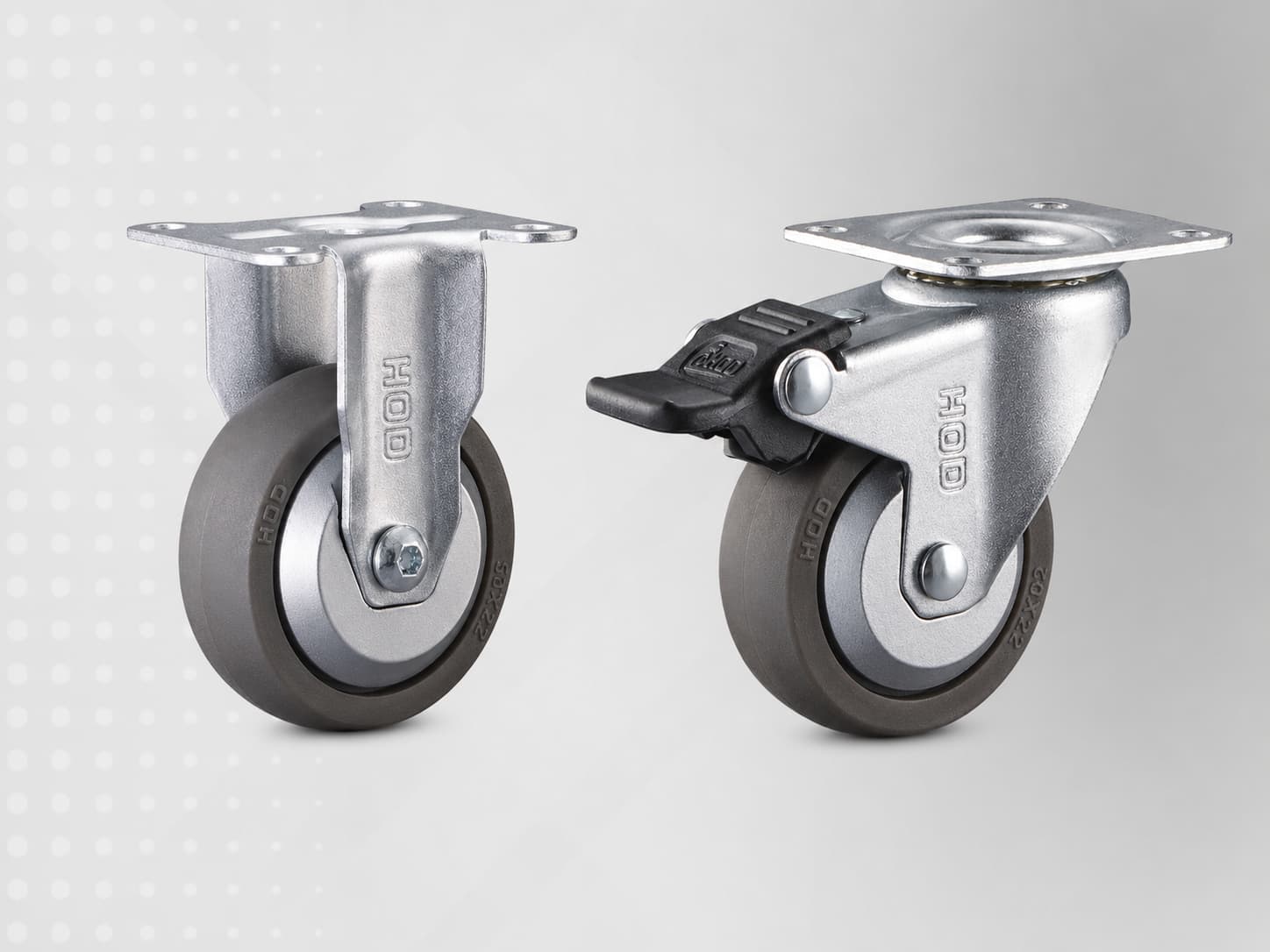
This guide is for laboratory managers, pharmacy supervisors and maintenance teams who buy casters for lab carts and sample trolleys. Lab and pharmacy trolleys are often cleaned. A wrong caster means a trolley out of use and a second order.
Start with the room, not the trolley
Write down where each trolley works. A lab cart may stay on one bench aisle. A sample trolley may travel between a lab, a corridor and a lift.
Note the floor in each place. Sealed floors, tile, lift gaps and door thresholds all matter to a small wheel. Wheel material affects noise and floor marks, so tell us about your floors.
Then note how often the trolley moves and how far. Also note how it is cleaned. Wiping with a cloth is one case. Frequent washing or strong chemicals are another, and they affect which wheel and bracket material you need.
Stainless steel and cleaning
If trolleys are cleaned often, tell us, and we will say if a stainless steel series fits. Our catalogue lists stainless steel casters in SUS 304 and 316L, in three series.
- S-Series, light duty: pure SUS 304 / 316L with TPR or pure nylon core wheels, in swivel, rigid and total lock. Our catalogue describes it as corrosion-immune and ideal for medical equipment and chemical labs.
- MC / M-Series, medium duty: a 3.0 mm to 4.0 mm frame bracket gauge and stainless steel precision bearings. It is listed up to 250 kg each.
- L-Series, heavy duty: heavy gauge SUS 304 with high temperature or solid nylon wheel options and an over-sized top plate.
Tell us the cleaning method and we will confirm which series to quote.
Our medical series
Our medical series is the HOD H7, H8 and H9 range, listed at 50 to 80 kg. These are swivel casters, each with or without a brake. The mounting choices are top plate, threaded stem, bolt hole and other stem fittings.
Weigh your own trolley fully loaded before you decide. Then check that the load per caster stays inside the listed range. If the trolley is heavier, tell us the load per caster and we will confirm which series to look at.
Send a photo of the old caster and any numbers you can read, and we will try to match it.
Brakes, loads and the number of casters
Add up the full weight: the empty trolley, the racks, the containers and the samples. Divide by the number of casters, then leave margin. Do not plan to the limit of a rating.
Decide which positions need a brake, and tell us how many casters should have one. If the trolley is used on a ramp or a sloped floor, tell us that as well.
Keep the casters on one trolley in the same series and wheel material, so they wear alike. When one caster fails, tell us the old codes so we can match the set.
Keep the old casters when you can. They show the mounting, the height and the wear pattern.
Documents for your quality team
Some sites need product documents for their quality file. If your quality team needs product documents, ask us, and tell us what the team requires. We will tell you what we can supply.
Rules differ from site to site, so check the requirements with your quality team before you order. Our caster finder can narrow the choice by mounting type and load.
What to send us for a quote
- What the trolley is, what it carries and where it works.
- Total loaded weight and the number of casters.
- Floor type in each area, including thresholds and lifts.
- How you clean: wipe, wash or hose down, and which chemicals.
- Mounting: top plate, threaded stem, bolt hole or other fitting. A photo or measurements of the old caster help.
- Swivel, rigid or brake, and how many of each.
- Any documents your quality team needs.
- The quantity you need.
Request a quote on our website or message us on WhatsApp, and we will confirm the right series for your conditions.