
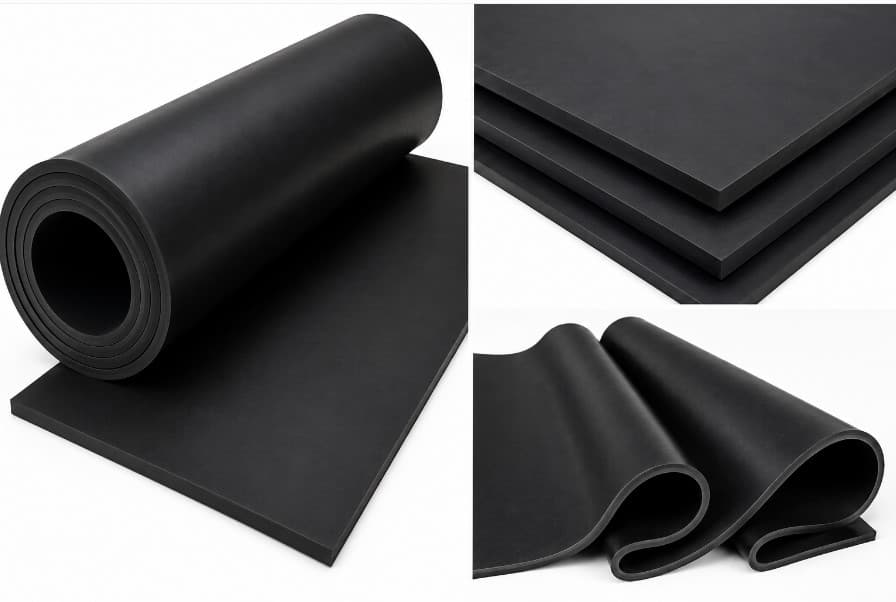
This guide is for facility managers, contractors and buyers who need rubber for outdoor sealing, waterproofing or insulation work. Here is what our catalogue says about EPDM sheet, and what to tell us so we can confirm it fits your job.
What our catalogue says about EPDM
Our catalogue describes EPDM rubber sheet as weather-resistant sheet for outdoor sealing, waterproofing and insulation work. That is the full description we hold, so we do not add claims beyond it.
For your project, this means we can discuss EPDM when the work is outdoors. But a sheet is only right if it suits your exact conditions. Tell us the conditions, and we will confirm.
Say where the sheet will be
Start with the place. Outdoor jobs vary a lot, so give us a clear picture.
Tell us where the sheet will go:
- Over a surface
- In a gap or joint
- As a cover or pad
- Around an opening
Say whether the sheet is in full sun, in shade, or sometimes under water. Say whether it will be walked on or have equipment placed on it.
Choose between a sheet and a seal
You may need a flat sheet to cut and fit yourself. You may need a seal in a set shape. Our catalogue lists both. Our rubber seals are described as flexible sealing solutions designed to help prevent leakage, vibration, dust and moisture entry.
Tell us whether you need a flat sheet or a seal, and we will confirm which to quote.
If you are not sure, send a photo of the gap and tell us how big it is. We will say whether sheet or seal is the better request.
Photos of the site help a great deal. Show the whole area, then a close view of the gap, joint or edge. Add a ruler or a tape measure to each photo, so we can read the size.
What else touches the sheet
Weather is only one condition. Check what else the rubber may meet, and tell us.
- Oil, fuel or grease from equipment nearby
- Cleaning chemicals or other chemicals
- Hot surfaces or pipes
- Sharp edges or rough surfaces that rub the sheet
EPDM is listed in our catalogue for weather, not for every fluid. If oil or fuel is present, tell us, because our catalogue lists other sheets, such as nitrile, for oil-resistant work. We will confirm the right choice. You can see the full list on our industrial materials page.
Write down how long the rubber must stay in place, and whether the area is easy to reach later. Tell us if the job is new work or a replacement of old rubber. If it is a replacement, say what failed and send a piece of the old rubber if you have one.
Sizes, fixing and site work
Measure the job before you order. A sheet that is too small leaves a gap at the edge. Measure twice and add a margin for fitting.
Tell us the length and width of the area, the thickness you need, and how many pieces. For seals, give the length and describe the shape of the gap. Measure any overlaps too.
Tell us who will cut and fit the sheet, with what tools, and whether there is a clean, dry surface to fix it to. Tell us the condition of the surface and how the rubber will be held, for example glued, clamped or bolted.
If the job has several areas, list them one by one with their sizes. Send a photo of the site, with a ruler or a tape measure in view.
What to send us for a quote
Send us this information, and we will confirm the material and the size:
- Whether you need EPDM sheet, a seal or both
- Where it will be used, with a photo of the site
- Whether the sheet is in full sun, shade or water
- Anything else that touches it: oil, fuel, chemicals or heat
- Sizes with units: length, width, thickness and the number of pieces
- How the rubber will be fixed in place
Request a quote on our website or message us on WhatsApp, and we will confirm the right material.