
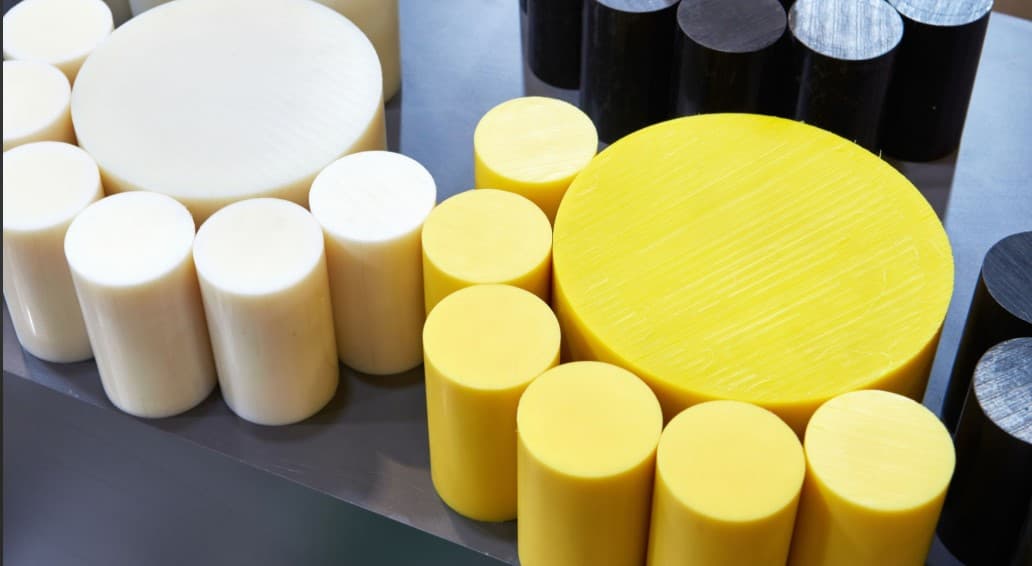
This guide is for maintenance managers, workshop supervisors and buyers who order nylon or PTFE (Teflon) rod. Ordering the wrong material means a part that wears out early or a second order. A clear inquiry helps us confirm the right material for the job.
Start with the material name
If your drawing or specification names a material, copy it into your inquiry exactly. Do not write "plastic rod" alone. Tell us whether you need nylon, PTFE or help choosing.
Nylon and PTFE are different materials, and one is not a drop-in replacement for the other. Tell us what the part does, and we will help you choose. If you want to change the material on an existing part, tell us first. We will help you compare the new material with the old one before you commit.
Our industrial materials catalogue lists both materials. It also lists rubber sheets, gaskets and coatings.
Nylon rod and sheet
Our catalogue lists nylon rod and sheet as strong engineering plastic for machining, rollers, spacers and wear parts. If your part is one of these, say so in the inquiry.
Tell us:
- The rod diameter, in millimetres.
- The length you need, in metres or millimetres.
- How many pieces you need.
- Whether you need rod, sheet or both.
If you need a special size, tell us and we will check what we can offer. Use the same units everywhere in the inquiry, so nothing is misread.
If you plan to machine the rod yourself, tell us the finished part and its size. Our catalogue lists nylon as suitable for machining, so this helps us pick a rod size with enough material for your part. Send a sketch if you have one.
Teflon (PTFE) rod and sheet
Our catalogue lists Teflon rod and sheet as low-friction PTFE for chemical resistance, insulation, guide parts and machine components. Send the same size details as for nylon: diameter, length and quantity.
If the rod will touch chemicals, name them. Tell us the strength of each one if you know it. Then we can confirm the material against your list.
If the part is a guide or a machine component, tell us how it moves and what it touches. Low friction and chemical resistance are the points the catalogue lists for PTFE. Your list of conditions tells us whether they matter for your job.
Explain how the part will be used
A short description of the job saves many questions later. Describe what the part does in the assembly and whether it moves or stays still.
Tell us:
- What the part is: a roller, a spacer, a guide, a wear part or something else.
- The load it carries, if you know it.
- The temperature range where it works.
- Any fluids or chemicals that touch it, such as water, coolant, solvent or cleaning liquid.
- Whether the contact is occasional or constant.
- Whether it rubs against another part.
Do not worry if you cannot answer every point. Send what you know, and we will ask for the rest. A photo of the old part or of the machine also helps. If you need product documents, ask us.
Compare quotations fairly
When you compare quotations, check that each one offers the same material and the same size. A lower price may cover a different material or different dimensions. If we offer an alternative to your specification, we will tell you what is different.
Keep the quotation for your records. Note the material name and the sizes. For a repeat order, send those details again, and the new quotation is easier to check.
What to send us for a quote
- The material name from your drawing or specification, or what the part does.
- Nylon, PTFE or both.
- Rod, sheet or both.
- The rod diameter, the rod length, or the sheet size and thickness.
- The quantity you need.
- What the part does, and the load it carries.
- The temperature range, and any fluids or chemicals that touch it.
- Any special size you need.
Request a quote on our website or message us on WhatsApp, and we will confirm the right material for your job.