
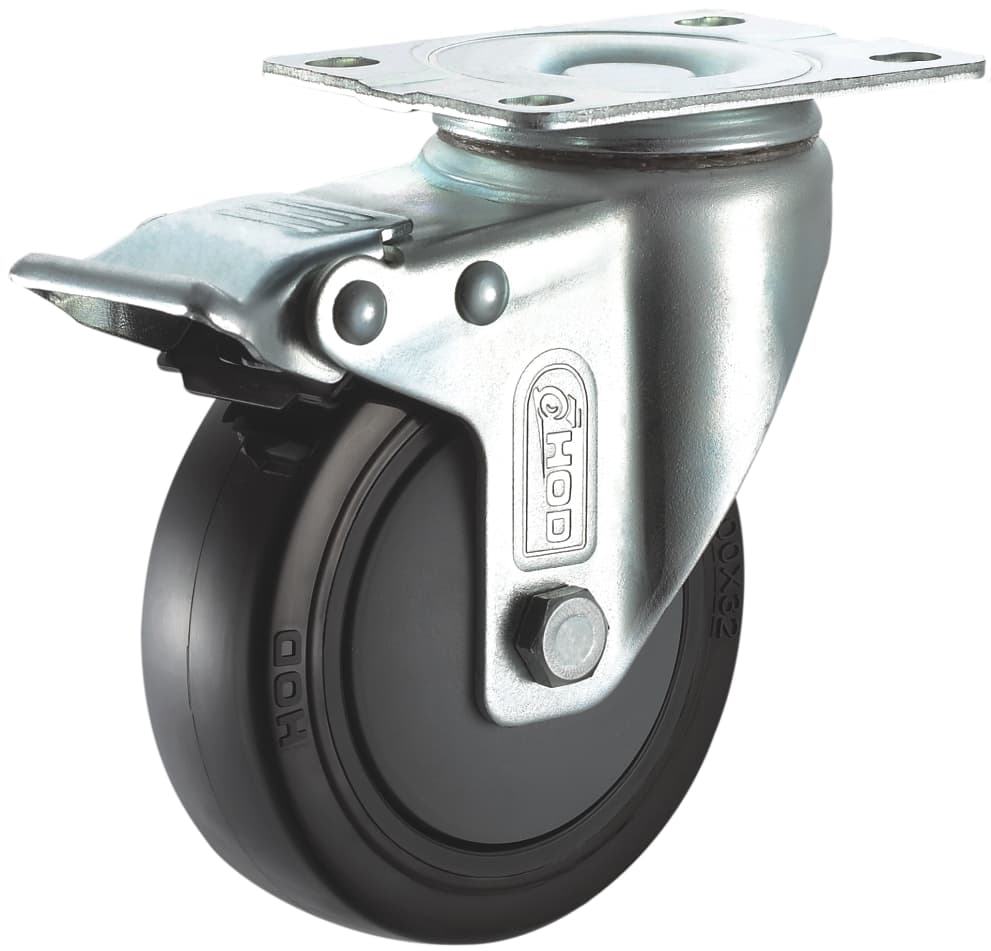
This guide is for maintenance teams and buyers who must replace a failed caster. A replacement that almost fits means a wrong order and equipment out of use. Take the photos and measurements below before you contact us, and we can match the caster faster.
Photograph the old caster
Take photos from the side, from underneath and at the point where it fixes to the equipment. Include any stamped code or label. A ruler beside the caster gives a sense of scale.
Send a photo and any numbers you can read, and we will try to match it. If you cannot read a code, say so. A clearly stated unknown is better than a guess.
Keep the old caster until the new one arrives. It is the best reference you have.
Note how it turns and brakes
Check whether the caster is rigid, so it only rolls forward, or swivel, so it turns. Then check for a brake. A brake can lock the wheel, the swivel or both.
Tell us which one yours does. Take a photo of the brake lever or pedal. If the equipment has more than one caster type, list each position.
Our light duty series is listed at 8 to 65 kg per caster, with swivel and rigid casters. Some groups in that series come with a brake.
Measure the mounting
Casters fix to equipment with a top plate, a threaded stem, a bolt hole or another fitting. Find out which one you have. Each needs different measurements.
For a top plate, measure the plate length and width. Then measure the distance between the centres of the holes in both directions. Note the hole size.
For a threaded stem, measure its diameter and its length. Note the thread size if you know it. For a bolt hole, measure the width of the hole.
Write every measurement with its unit, such as millimetres. Add a simple sketch that shows what you measured. Do not guess a thread size from a photo.
Measure the wheel and the height
Measure the wheel across its full round width and the width of the tread. Then measure the height from the floor to the top of the caster. A replacement that is a little taller can change how the equipment sits.
Also note the space around the caster. A caster that swivels needs room to turn. A brake pedal needs room too.
Send all these figures with your photos. We will check them against the catalogue.
Give us the job
The replacement must fit the equipment, and it must suit the job. Write down the loaded weight and the number of casters. Tell us how the equipment moves, and whether people push it or a vehicle tows it.
Add the floor type. Also tell us about water, chemicals or heat. Do not judge the wheel material by its colour. A black wheel can be made from several materials.
Tell us the conditions, and we will confirm the right series. Our medium duty series is listed at 30 to 170 kg per caster. It has top plate, threaded stem and bolt hole versions.
Check the quotation before you order
When we send a quotation, it gives the product code and a description of the caster. Compare it with your measurements. Check that the mounting type matches, the height fits and the footprint has room.
If the replacement differs from the old caster in any way, ask us to list the differences. For example, it may be a little taller or have a different bolt hole pattern.
Keep the photos, your measurements and our quotation together. They become the reference for future orders. You can also use the caster finder to filter by mounting type.
What to send us for a quote
- Photos of the caster from the side, underneath and at the fitting.
- What you need to replace. We will say what we can supply.
- The mounting: top plate, threaded stem, bolt hole or another fitting, with its measurements.
- The wheel diameter and the tread width.
- The overall height and the space around the caster.
- Rigid, swivel or brake, and what the brake locks.
- The equipment weight and the number of casters.
- The code or any marking on the old caster.
Request a quote on our website or message us on WhatsApp with your photos, and we will confirm the replacement.