
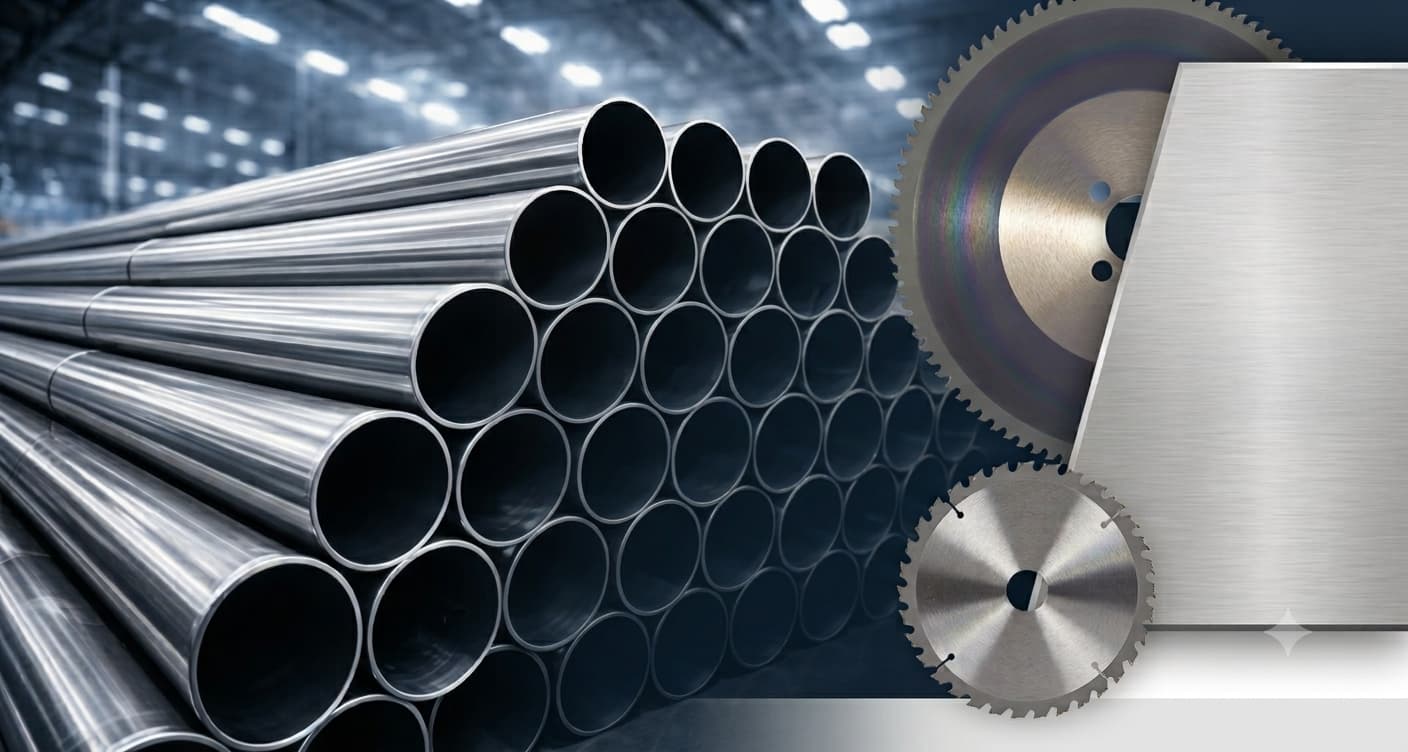
This guide is for workshop supervisors, maintenance managers and buyers who order saw blades for tube, pipe and bar. The wrong blade means a stopped saw, scrap material and a second order. A complete inquiry helps us confirm the right blade the first time.
Name the cutting process
Start with what you cut and how the machine works. Our Kinkelder blade lines are listed by application, such as flying cut-off, stationary tube and solid bar. So the process comes before the blade model.
Tell us:
- Whether you cut tube, pipe, profile or solid bar.
- Whether the saw is stationary, semi-automatic or cuts on the fly.
- The make and model of the machine, if you know them.
- Whether one machine cuts one material or several.
If one machine cuts different sizes, list the full range. A saw that changes size often needs more detail than one that runs a single section all day. Tell us which case is yours. Our saw blade range shows every line, and each line has its own finder.
Flying cut-off on a tube mill
A flying cut-off saw cuts pipe or profile while the line keeps running. Our catalogue describes the KINS' ORANGE series as TCT circular saw blades engineered for flying cut-off on tube mills. It lists hollow sections, square tubes and rectangular tubes.
Tell us the tube size, the wall thickness and the line speed. Also tell us whether you cut carbon steel, stainless steel or both. The ORANGE finder lists separate versions for each.
Solid bar in a stationary saw
Solid bar and tube need different blades, so do not order by size alone. Our KINS' RED line is listed as a TCT solid stationary line, for solid steel bars and other dense metals. The catalogue shows LF, MT, HT and stainless versions.
Tell us the bar size and the steel grade from your specification. If you do not have the grade, tell us what the bar is used for. We will help you from there.
Describe the workpiece
Describe the material the way it appears on your purchase order or job ticket. Give the name from your specification, such as carbon steel or stainless steel. Add the grade or code if you have one.
For tube and hollow section, tell us:
- The outside diameter, or the width and height.
- The wall thickness.
- The shape: round, square or rectangular.
For solid bar, give the diameter, or the section size. Use millimetres for every size.
If something is wrong with the current cut, describe it. Does the blade wear quickly, leave a rough surface or chatter? Do not guess the cause. A photo of the cut and the blade helps us a great deal. Send one of a good cut as well, if you have it.
Tell us about your existing blade
If a blade is already on the machine, send its details. Look for the code or model name marked on it. Then measure the diameter, the bore and the thickness. Count the teeth, and note the hole pattern used to fix it.
Write "unknown" for anything you cannot read. A field marked "unknown" is more useful than a wrong number.
Also tell us how the blade is fixed to the machine, and how it is cooled. If you know the current speed and feed, send those too. We may ask for more detail, but this gives us a good start.
If you move to a blade you have not used before, follow the machine maker's instructions for fitting it. Your site safety officer sets the rules for your saw. Tell us what the maker requires.
What to send us for a quote
- The name and model of your cutting machine.
- The process: flying cut-off, stationary tube or solid bar.
- The material, its grade, its size and its shape.
- The wall thickness, for tube and hollow section.
- The current blade code and dimensions, if you have them.
- How the machine fixes and cools the blade.
- A photo of the cut or the blade, if something is wrong.
- The quantity you need.
Request a quote on our website or message us on WhatsApp, and we will confirm the right blade for your job.