
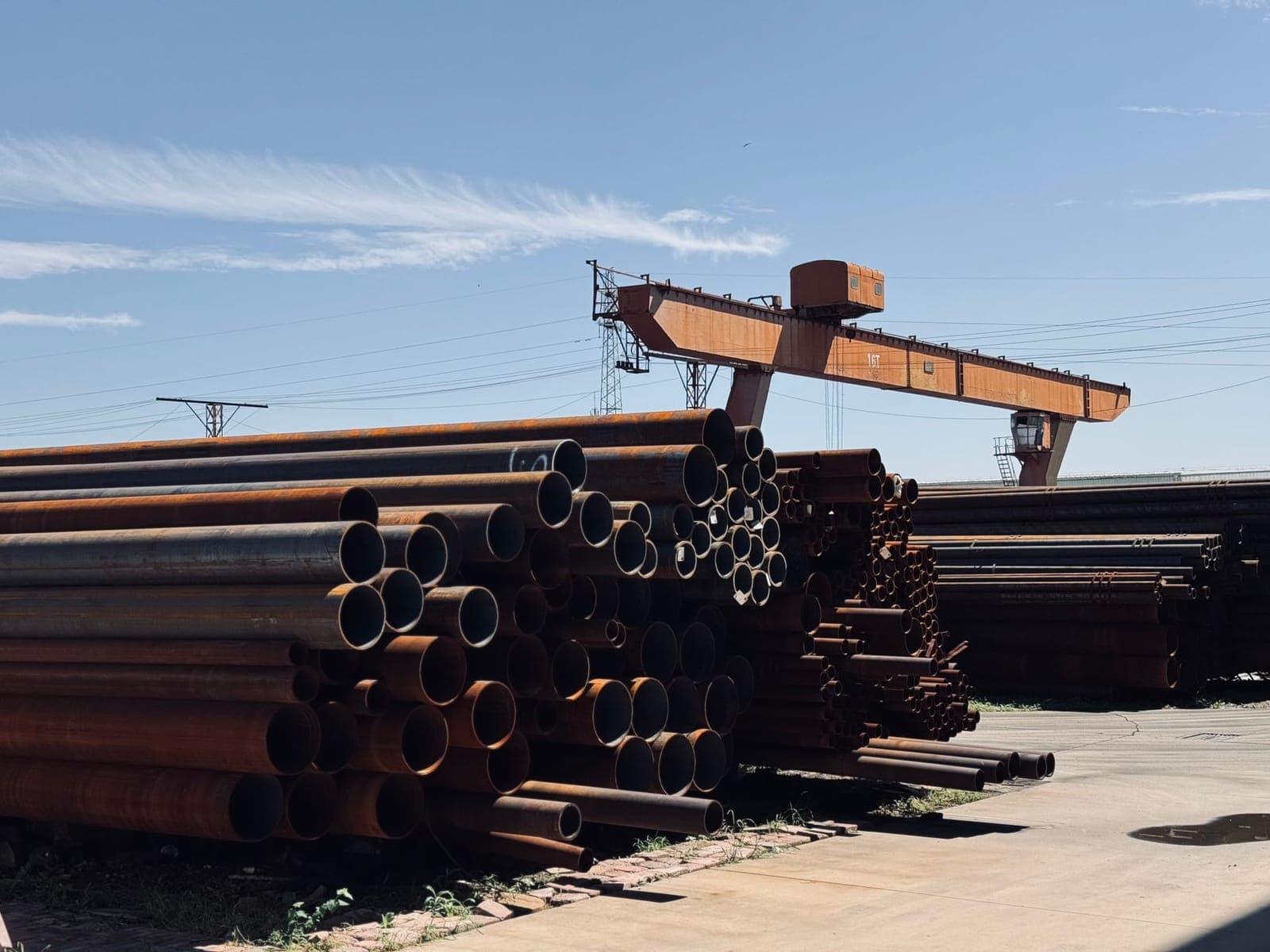
This guide is for production managers, maintenance teams and buyers at tube mills and steel workshops. It helps you pick the right blade line for tube and pipe before you order. A wrong blade costs you downtime, poor cuts and repeat orders.
Start with how the tube is cut
The first question is not the blade. It is the machine and the way the line runs. Tube is cut in two very different ways, and each one has its own blade line.
- Flying cut-off: the saw travels with the tube and cuts it while the mill keeps running.
- Stationary or semi-automatic cutting: the tube is held still and cut to length on a saw.
Tell us which process you run, and we will start from the right line.
Flying cut-off on a tube mill
On a tube mill, the line cannot stop for every cut. A flying cut-off saw cuts hollow sections, square tube and rectangular tube without stopping or slowing the production line. Your blade choice decides how long the line runs.
Kinkelder's KINS' ORANGE range is made of TCT (tungsten carbide tipped) circular saw blades for this job. The range has several versions, so you can match the blade to your tube:
- SpeedMaster and SpeedMaster Performance, for carbon steel tube. The finder rates SpeedMaster Performance highest for thin tube and profile.
- ScarfMaster LMT for low and medium tensile steel, and ScarfMaster HT for high tensile steel.
- OrbitalMaster Pro, rated for both tube and profile.
- OrbitalMaster Stainless, for stainless steel.
Stationary and semi-automatic tube cutting
Many workshops and stockholders cut tube, pipe and profile to length on a stationary or semi-automatic saw. The KINS' BLUE range is TCT blades for this work. It covers different steel grades and tensile strengths, so it suits shops that cut more than one kind of tube.
The versions differ in what they do best:
- Stabilizer Performance and Performance, for a good cut surface on low to high tensile steel.
- Multi Performance, rated highest for multi or thick tube, where you cut bundles or heavy wall.
- Stainless, for stainless steel tube.
The size and specification of the blade depend on your machine, the cutting task and the material. This is why we ask for details before we quote.
What decides the right blade
Use this list to check your own job before you call us.
- Material: carbon steel, stainless steel or another grade. The finder lists stainless versions in each line.
- Tensile strength: low, medium or high. The finder rates each blade for these.
- Tube shape: round, square or rectangular, thin wall or thick wall, single tube or bundle.
- Machine: make, model and blade size it takes.
- Problem today: short blade life, rough cuts, or burrs. Describe what you see.
Take photos of the old blade and of a sample cut if you can. They show us what you see at the saw, and they save a round of questions.
We do not quote a cutting speed or feed from a general guide. These depend on your machine and material, so ask us and the machine maker.
Avoid the common ordering mistakes
Check your own order against this list before you send it. It takes a few minutes, and it can save you a second order.
- Ordering by the old blade's outside size only, without checking bore and fixing holes.
- Using a blade without telling us if you cut stainless as well as carbon steel.
- Changing the blade line without telling us that the process is different.
- Buying the cheapest blade and then paying more in stops and scrap.
You can see the full range on our saw blade page. If you are unsure between two lines, send us the details and we will confirm the right one.
What to send us for a quote
- Process: flying cut-off or stationary, and the machine make and model.
- Tube material, shape, outside size and wall thickness. Give the range if it changes.
- The old blade's code, or its diameter, bore, thickness and fixing holes.
- What is wrong with the current blade, with photos of the cut if you have them.
- Quantity and delivery location.
Request a quote or message us on WhatsApp, and we will confirm the right blade for your line.