
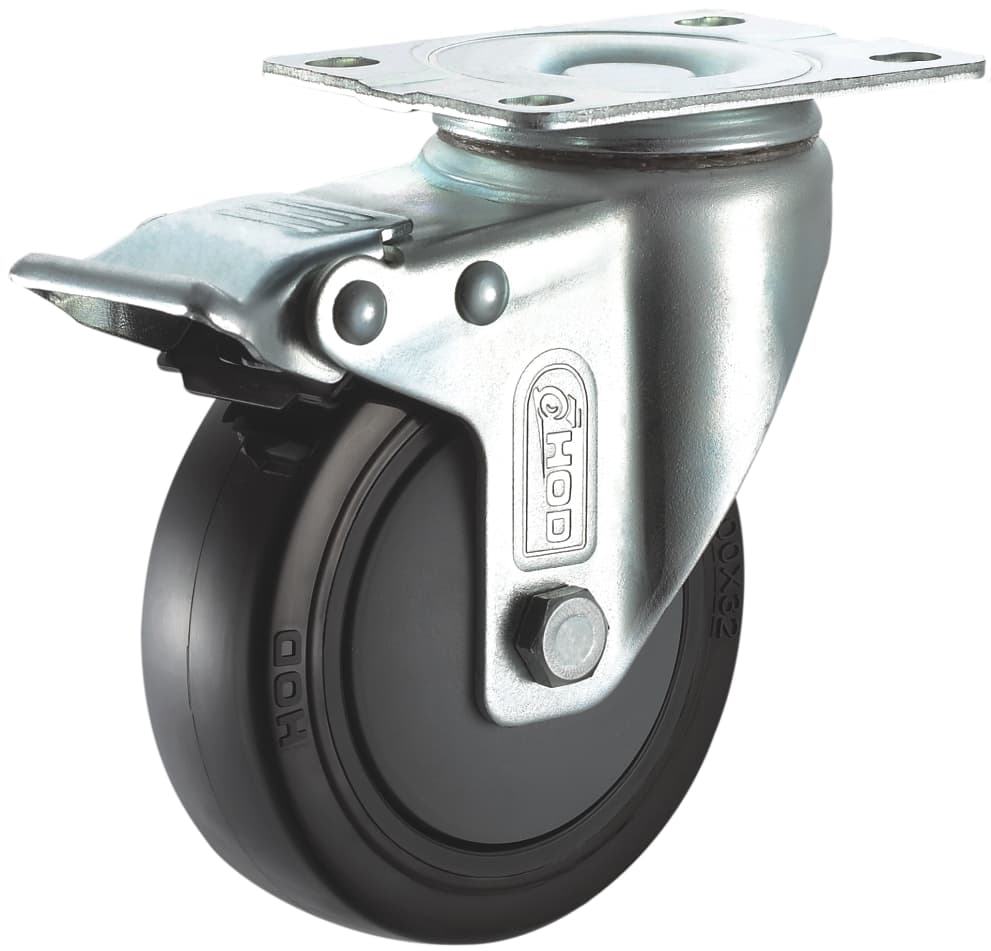
This guide is for maintenance teams, workshop supervisors and buyers whose trolleys wobble, shimmy or flutter on swivel casters. The cause can be in the fitting, the frame or the floor, not only in the caster, so a new caster can shimmy too. Here are the causes to check, in the order that saves most time.
Note when and where it happens
Before you touch anything, write down when the shimmy shows up. This narrows the search.
- Only when the trolley is empty, or only when it is loaded.
- On one floor, or on every floor.
- On one corner, or on all casters.
- Only when the trolley is pushed by hand, or only when it is pulled.
- Since a certain date, an impact or a change of casters.
A wobble on one corner points to that corner. A wobble on every caster points to something shared: the set, the load or the floor.
Check the fitting and the frame
Look at the mounting first. A gap or a bent frame can make a good caster lean. Tick off each point.
- The top plate sits flat against the frame, with no gap at one edge.
- All the fixing bolts are present and tight. Follow your maintenance instructions for fastening.
- A threaded stem is seated fully in its socket and is not worn.
- On a bolt hole fitting, the hole is sound and not worn oval.
- The frame is not bent or twisted from a knock.
If you see a fault here, send us a photo of the fitting and tell us what you found.
Check the wheel and the swivel
Next, look at the caster itself, under your site's own safety rules for lifting a trolley. Compare each caster with the others on the same trolley. The odd one out is where to start.
Look for a wheel with a flat spot or uneven wear, a swivel that feels rough or loose, and a fork or axle that leans. Our caster wheel maintenance checklist covers the routine inspection. Our guide on when casters need replacing helps you decide.
When a caster is worn or bent, tell us the old code so we can confirm a replacement.
Check the load and the set of casters
Check the load per caster against the series rating. Weigh the loaded trolley, divide by the number of casters, and leave a margin. On an uneven floor, one wheel can lift and the others carry more, so do not count on all four sharing the load equally.
Also check that the casters on one trolley match. Different series or wheel materials on one frame can leave one caster carrying more than its share. Tell us the series, wheel material and overall height of the old casters, and fit the same on every corner.
Casters in our catalogue
We cannot say that one series will cure a shimmy, because the cause can be in the fitting, the floor or the load. What we can do is show you what the catalogue lists.
Our medium duty series is the HOD 51 and 52 range. The catalogue rates the single ball bearing series at 30 to 160 kg. It rates the double ball bearing series at 35 to 170 kg.
Our heavy duty series is the HOD 72 and 73 range, rated from 120 to 505 kg per caster.
You can also filter by mounting, wheel material and load in our caster finder.
What to send us for a quote
- A short description of the fault: when it starts, and on which corner.
- Photos of the casters, the fitting and the frame.
- The old caster code, or the series and wheel material if you can read them.
- The fitting: top plate, threaded stem, bolt hole or other fitting.
- The loaded weight of the trolley and the number of casters.
- The floor type, and any dirt or debris you find.
- Rigid, swivel or brake, and how many of each.
- The quantity you need.
Request a quote on our website or message us on WhatsApp, and we will confirm the right series for your trolley.