
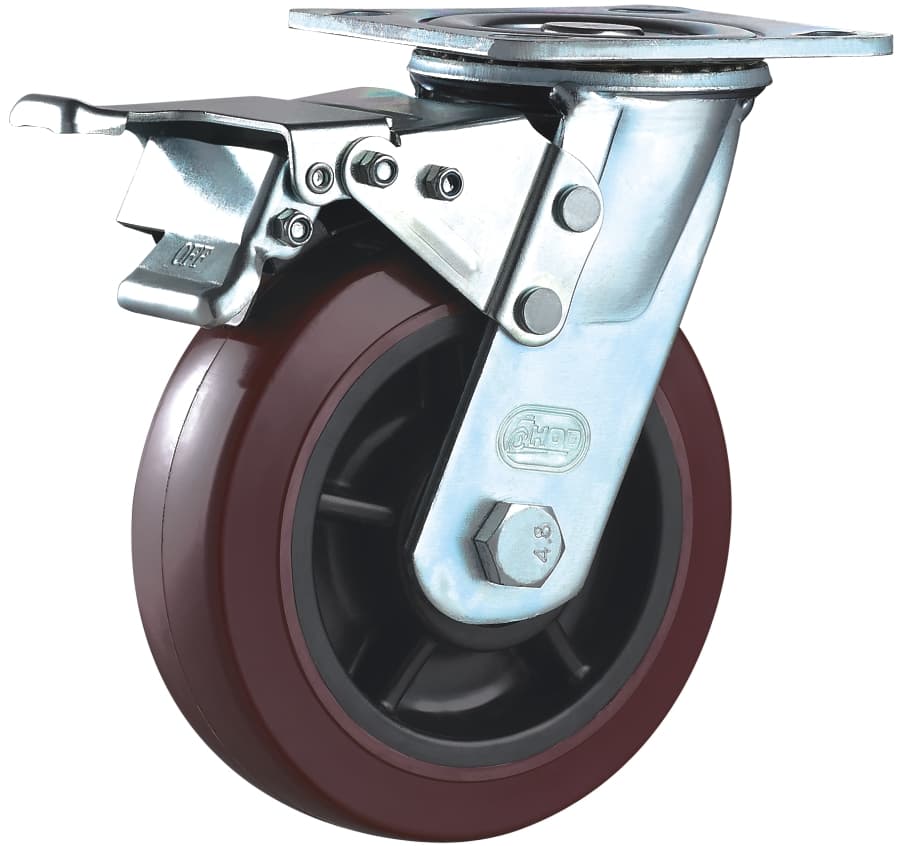
This guide is for logistics managers, warehouse supervisors and maintenance teams who fit casters to dock trolleys and roll cages. A wrong caster means a stuck cage and a second order. Here is how to narrow the choice and what to tell us.
Start with the loaded weight, not the empty one
Weigh the empty cage or trolley first. Then add the heaviest load it carries on a busy day, not the average one.
Divide the total by the number of casters on the carrier. Then leave a margin, because a floor that is not flat can put more weight on one caster than on the others.
Our catalogue gives a load rating for each wheel option, so the rating belongs to the exact caster code. Do not compare only the series name. Compare the rating for the wheel you want.
If the result sits near the top of a range, do not order it as it stands. Tell us the loaded weight and the number of casters, and we will help you decide whether to move up a series.
A roll cage and a dock trolley are not the same carrier, so give us the weight of each type you run. A cage that is loaded with light goods and a trolley that carries heavy items will need different figures.
Heavy duty series
Our heavy duty series is the HOD 72 and 73 range, listed at 120 to 505 kg per caster depending on the wheel. For the general method of sizing casters on warehouse trolleys, see our guide on choosing casters for warehouse trolleys.
Medium / heavy duty series
Our medium / heavy duty series is the HOD 62 range. The catalogue lists double bearing wheels and ratings from 80 to 330 kg per caster. It has seven wheel options in PP, PU, PA, ER and TPR.
It is listed with top plate, threaded stem and bolt hole fittings, with brake options. Check which fitting your cage or trolley base has before you compare ratings.
Platform trolleys
Our catalogue also lists platform trolleys in three models. Our guide on hand trucks and platform trolleys covers them, and you can filter by load in our caster finder.
Daily travel, rigid and swivel casters, and brakes
Write down every trip a carrier makes in a day. A cage may go from the dock to a sorting area, then to a vehicle and back. Each stop can have a different floor, and each floor treats a wheel differently.
Tell us if the floor is smooth, rough or marked by joints, and if the route has ramps or thresholds. Dock edges and plates between the dock and the vehicle are worth a mention too. If trolleys run near people or on a sensitive floor, tell us that too. Wheel material affects noise and floor marks.
Note how your current carriers are set up: how many casters swivel, how many are rigid, and which have a brake. In our catalogue the brake versions are swivel casters, and rigid casters are listed without a lock. If you need to hold a cage in place, tell us how you load it and how many casters you want braked.
Fleets need one more check. When you order for many carriers, tell us how many of each type you run. Keeping the same series, wheel material and code across a fleet makes the next order easier to match.
If you replace casters, send us the old ones or a photo of them. The codes and the fitting tell us what to match.
What to send us for a quote
- What the carrier is: a roll cage, a dock trolley or another type.
- The empty weight and the heaviest loaded weight.
- The number of casters, and how many are swivel, rigid or braked.
- The fitting: top plate, threaded stem, bolt hole or other fitting.
- A photo of the old caster, with any code you can read.
- The floor and the route, including ramps and thresholds.
- The quantity you need.
Request a quote on our website or message us on WhatsApp, and we will confirm the right series for your carriers.