
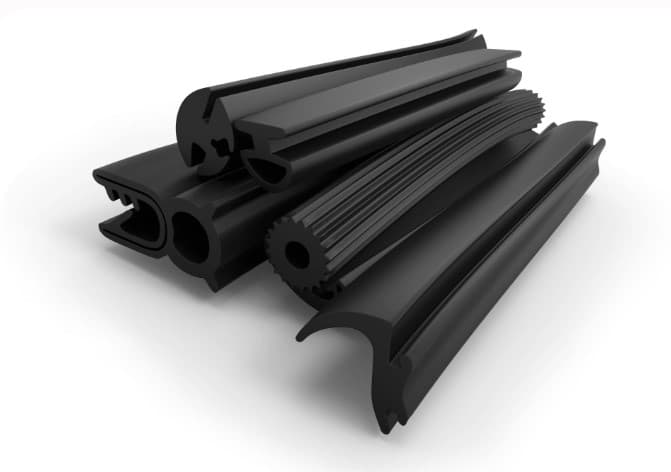
This guide is for maintenance managers, workshop supervisors and buyers who need to replace a rubber seal and have no part number. The old seal is often the only reference you have, and it is worn. Here is how to prepare it so we can confirm the right material and size.
Why a worn seal is hard to match
A worn seal may no longer have its original shape, so measure it with care. A single measurement can send you to the wrong order.
Do not trust one reading. Measure in several places and write down the range. Tell us which parts of the seal look worn and which look close to new.
Colour alone does not tell us what the rubber is. So we ask what the seal touches, not what it looks like.
Keep the old seal
The old seal is the best sample you can give us. Keep it in one piece if you can, and do not pull it straight to measure it, because a stretched seal gives a false length. If it broke, keep all the pieces. Even a short piece shows the shape of the section.
If the seal is glued to a face or sits in a groove, tell us how it was held. For the signs of a failed seal, see our guide on signs a rubber seal needs replacing. For door and enclosure seals, see rubber seals for dust and moisture.
Our catalogue does not list a set of seal profiles. So a sample or a clear photo is how we check what you need. Tell us if you cannot send the sample, and we will see what else helps.
What to measure and photograph
Measure what you can, and write the units next to every number. Then add photos for the rest.
- The full length of the run, including corners and joins
- The width and height of the seal, taken at the thickest and thinnest points
- The size of the groove, face or edge where it sits
- How many pieces you need, and whether they join into a frame
For photos, show the whole seal, then the place it fits, then a close view of the end of the seal. Put a ruler or tape measure in the picture. A photo from the side shows the shape of the section better than a photo from above.
Tell us where it sits and what it does
The place where the seal sits matters as much as its size. A seal on a door, a hatch, a pipe joint and a machine housing each face different conditions.
Our catalogue describes rubber seals as flexible sealing solutions designed to help prevent leakage, vibration, dust and moisture entry. Tell us which of these is your problem.
Tell us:
- Where the seal sits, and whether it stays still or moves
- What it must keep in or keep out
- Whether it is indoors or outdoors
- Whether it touches oil, fuel, water or cleaning chemicals
If a chemical is involved, give us its name. A general word such as "chemicals" does not help us confirm the material.
When the old part is flat rubber
Some old seals are flat strips or pads, not shaped sections. If yours is a flat piece, tell us the thickness and the outline.
Our catalogue lists rubber sheet in EPDM, nitrile, Viton, NR / SBR and neoprene.
We do not choose between sheet and seal from a description alone. Send the sample and the conditions, and we will confirm which product to quote and what we can offer in your size. You can also browse the industrial materials page before you write to us.
What to send us for a quote
- The old seal, or all its pieces, or clear photos of it with a ruler in the picture
- The full length, the width and the height, with units
- A photo of the place where it sits, taken before you remove the seal if you can
- Where it sits, what it must keep in or out, and whether it moves
- Whether it is indoors or outdoors, and what it touches
- The number of pieces you need
If you need a certificate or other papers for the material, ask us for the product documents. Request a quote on our website or message us on WhatsApp, and we will confirm the right material and size.