
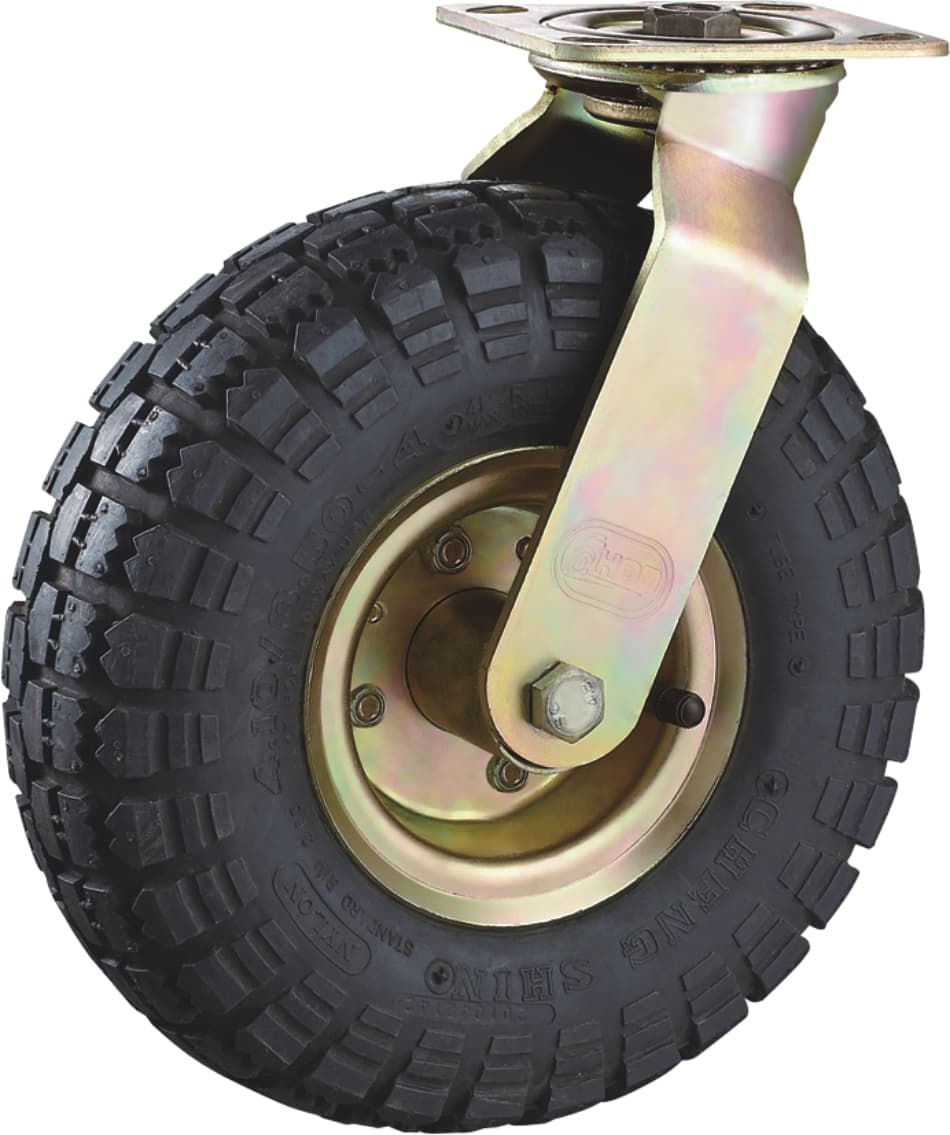
This guide is for buyers who have a trolley or machine on rough ground and are choosing between an air-filled wheel and a foam wheel. We list both in our catalogue. Here is how they differ on paper, and what to tell us so we can confirm the right one.
What the catalogue lists for each
Our catalogue has one pneumatic series and one foam series. Both come with double bearings and a top plate fitting. Neither entry says anything about floors, so the choice rests on your load, your ground and the facts below.
- Pneumatic (G3): pneumatic wheels, rated at 160 to 220 kg. Listed as a swivel top plate caster and a rigid top plate caster.
- Foam (E3): foaming wheels, rated at 160 to 260 kg. Listed as swivel, swivel with brake and rigid top plate casters.
The two ratings overlap between 160 and 220 kg. In that range the load alone does not decide, so the other points in this guide matter.
Air-filled or foam: the practical difference
A pneumatic wheel is air-filled, so someone has to keep the air right. A foam wheel has no air to fill, so there is no pressure to check.
We do not rank one above the other. The catalogue does not say that either wheel is better on rough ground, and we do not want to guess for your site.
What we can say is that the two wheels ask different things of your team. Decide who will look after the wheels, and whether they have the time.
So the question for your site is partly about people, not only about the floor. A wheel that needs regular attention only works if someone owns that job. Write the name of that person or team into your enquiry.
If equipment stands still for long periods, tell us. How long a trolley sits between moves is a fact we want before we confirm a wheel.
Brakes: only one of the two has a listed brake
Check this early. Our foam series is listed with a swivel caster that has a brake. Our pneumatic series is listed as swivel and rigid casters only, with no brake version.
If the equipment must stay in place, check this first. Our pneumatic series has no brake model to order.
Tell us how you hold the equipment now, and how many casters you want braked. We will confirm what the catalogue offers.
Where the shock absorbing series fits in
Our catalogue also lists a shock absorbing series, HOD D1, with double bearing wheels, rated at 200 to 400 kg. Tell us what you are protecting and we will confirm which series to quote. Our guide to shock absorbing casters for sensitive equipment covers that series.
Describe the ground and the load
Wheel choice starts with facts about your site, not with the wheel name. Write down what the wheel rolls over, and what it carries.
- The ground: rough concrete, gravel, cracked floor, ramps, kerbs or a mix.
- Whether the ground is dry, wet or dusty.
- Whether sharp objects, such as screws, glass or metal offcuts, can lie on it.
- Heat or chemicals the wheel will meet.
- The loaded weight of the equipment and the number of casters.
Divide the loaded weight by the number of casters, then leave margin below the top of the rating. One caster can carry more than its share on uneven ground. Our caster finder filters by mounting, wheel material, brake and load, which helps you shortlist before you write to us. For yards, gravel and ramps, read our guide to casters for outdoor and uneven ground.
What to send us for a quote
- What the equipment is and what it carries.
- Total loaded weight and the number of casters.
- The ground it rolls on, and anything on it such as water, grit or sharp objects.
- Heat, chemicals or oil the wheels will meet.
- Whether you need swivel, rigid or brake casters, and how many of each.
- The fitting on your frame: top plate, or another fitting. A photo of the old caster helps.
- Who will look after the wheels, and how long the equipment stands between moves.
- The quantity you need.
Request a quote on our website or message us on WhatsApp, and we will confirm the right series for your ground.