
This guide is for maintenance teams and buyers who must replace a sealing part. Many are not sure whether it is a seal or a gasket. Here is how to tell them apart, and what to send us so we confirm the right one.
The short answer
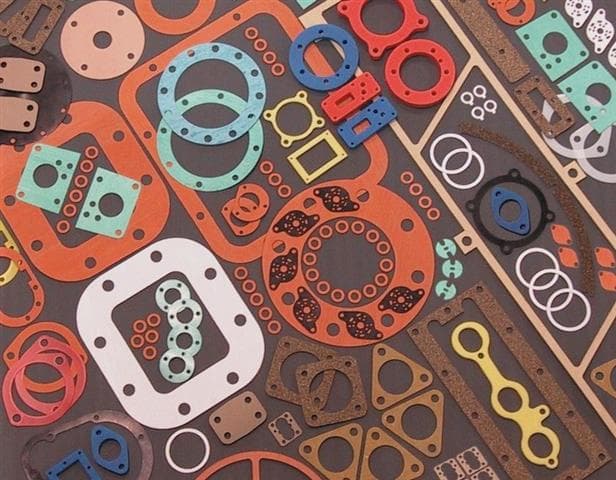
In general, a gasket sits between two surfaces that are fixed together and do not move against each other. The usual example is a pair of flanges on a pipe. The gasket fills the small gap between them when the bolts are tightened.
A seal usually blocks a gap where something opens, closes, flexes or moves. It can also block dust and moisture from entering a space.
These are general descriptions. Many parts sit between the two, and different trades use the words differently. So do not rely on the name your team uses. Look at where the part sits and what it does.
Gaskets in our catalogue
Our catalogue describes gaskets like this:
"Custom gasket materials for flange sealing, machinery, piping, and industrial maintenance."
The word "custom" matters, because the shape and size depend on your joint. Tell us what you need and we will confirm what we can offer.
Look at the joint you want to seal. A flat joint with bolts around it is usually a gasket joint. Tell us the shape of the joint and keep the old gasket for us to see. Our guide on how to measure a flange gasket shows which sizes to take.
Rubber seals in our catalogue
Our catalogue describes rubber seals like this:
"Flexible sealing solutions designed to help prevent leakage, vibration, dust, and moisture entry."
That list is a useful way to name your own problem.
Say which of the four you are trying to stop. Tell us if the part has to move, open or close. A seal that rubs against a moving part has a different job from a gasket that stays clamped. Photos of the part in place show us the gap, and that saves a round of questions.
Deciding which one you have
Check these points, then tell us the answers.
- Two flat parts bolted together: this is usually a gasket joint.
- A gap that opens and closes, or a part that moves: this is usually a seal.
- Dust or moisture getting into a space: the catalogue lists this under seals.
- Leakage between flanges or pipe joints: the catalogue lists flange sealing under gaskets.
Look at the part when the machine is open. Does it sit flat between two faces, or does it sit in a groove or on a door edge? Tell us which matches your part.
If you are replacing a part that has already failed, our guide to the signs a rubber seal needs replacing lists what to look for.
Some jobs fit neither description. If you are not sure which you have, send a photo of the old part in place and a photo of the gap. We will tell you which we think it is, and confirm before you order.
Keep the old part when you can, because it shows us the shape, the size and the fit.
The material comes next
Choosing between a seal and a gasket is the first step. The material is the second. Our catalogue does not say which material a seal or a gasket is made from.
Tell us what the part touches: water, oil, fuel, chemicals or weather. Tell us how hot it gets and how often it is opened or moved. We will confirm the material. You can see the full range on our industrial materials page.
What to send us for a quote
- A photo of the old part, and of the place where it sits.
- Whether it is a seal or a gasket in your view, and where you saw that name.
- The size of the old part, measured with its unit. For a flange joint, the outside size, the bolt hole count and the spacing.
- What the part is stopping: leakage, vibration, dust or moisture.
- What it touches, and the hottest temperature you expect.
- Whether the part moves, opens or stays clamped.
- If you have it, the old part itself or a drawing.
- The quantity you need.
Request a quote on our website or message us on WhatsApp, and we will confirm the right part for your job.