
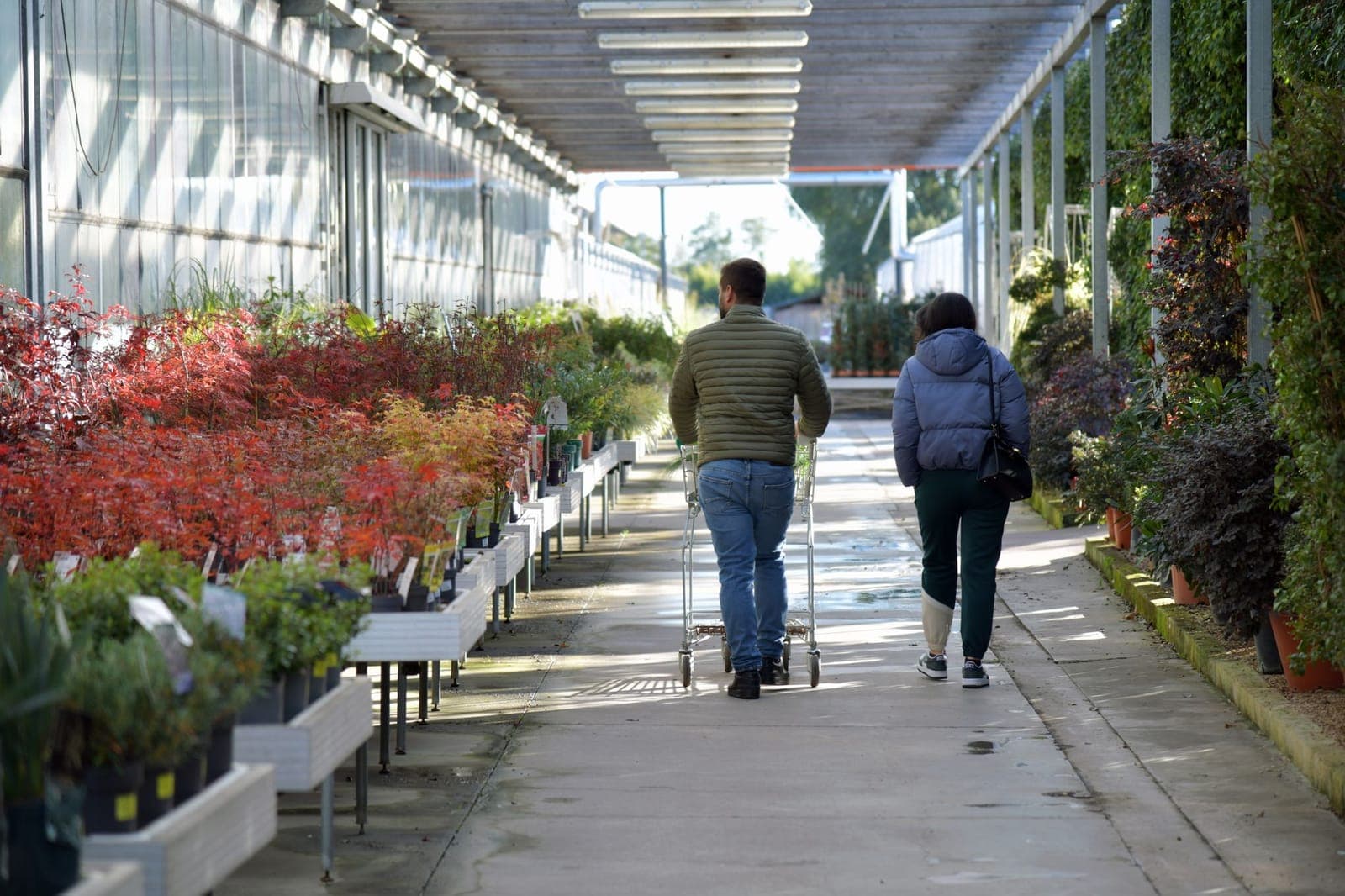
This guide is for nursery owners, greenhouse managers and farm supervisors who buy casters for plant trolleys and carts. Your carts may cross concrete, gravel and soil, and the load can change from day to day. Here is how to describe your carts to us, so we can confirm the right series.
Know your carts
Start with a list of the carts you run. Different carts carry different weights, so they may need different casters.
- Plant trolleys: potted plants and trays, moved between benches and the yard.
- Nursery carts: plants loaded for sale or for delivery.
- Farm carts: crates, tools, feed, produce or equipment moved around the site.
Write the loaded weight of each cart. A cart full of wet pots weighs more than the same cart with dry pots, so weigh it as it works. Tell us the weight, and we will confirm which series to quote.
Note how each cart moves, too. Say whether people push it by hand or pull it behind a vehicle, and how far it goes each day. A cart that travels all day across the site is a different request from one that moves a few metres between benches.
Know the route
Walk the route from start to finish and write down every surface. A cart may leave a smooth greenhouse floor, cross a concrete path, and then roll over gravel or soil.
Tell us about each surface, and about water on the floor. Wet floors and watering change which wheel and bracket material you need. Tell us if the carts stay outside overnight or stand in one place for long periods. Also tell us about steps, drains, door thresholds and slopes. For general advice on rough ground, see our guide on casters for outdoor and uneven ground.
Pneumatic series
Our pneumatic series is the HOD G3 range. It has pneumatic wheels with double bearing and is listed at 160 to 220 kg per caster. It comes as a swivel top plate caster and a rigid top plate caster. The catalogue lists no brake model for this series.
Tell us the ground and the loaded weight, and we will confirm whether to quote the pneumatic series. If you are weighing air-filled wheels against foam, see our guide on pneumatic or foam casters.
Medium / heavy duty and heavy duty series
Our medium / heavy duty series is the HOD 62 range, listed at 80 to 330 kg per caster. It has seven wheel options: PP, two PU, PA, two ER and TPR. It comes with top plate, threaded stem and bolt hole fittings, with brake options.
Our heavy duty series is the HOD 72 and 73 range, listed at 120 to 505 kg per caster. It has thirteen wheel options in YUPA, PU, Iron Core PU, PA, ER and TPR. It is listed as swivel top plate, swivel top plate with brake and rigid top plate casters.
If your loaded cart falls between two series, tell us the weight and the number of casters. We will confirm which one to quote.
Brakes, fittings and fleets
A cart parked on a slope or being loaded needs a plan for holding it still. A brake on at least two casters keeps a trolley from rolling on a slope. Tell us where the carts stop and whether the ground slopes there.
Check how the old caster is fitted: top plate, threaded stem or bolt hole. Our caster finder filters by mounting, wheel material, brake and load.
Measure the height from the ground to the underside of the cart frame, because the caster adds to it. Tell us if your carts must pass under a bench or through a door.
If you run many carts, use one series and wheel material across the fleet. Then replacements are easier to order and to match.
What to send us for a quote
- What each cart is, and what it carries.
- The full loaded weight, and the number of casters.
- The surfaces on the route: concrete, gravel, soil or others.
- Whether floors are wet, and how often.
- Rigid, swivel or brake, and how many of each.
- The mounting type, with a photo or measurements of the old caster.
- The quantity you need.
- Any product documents your purchasing team needs.
Request a quote on our website or message us on WhatsApp, and we will confirm the right series for your carts.