
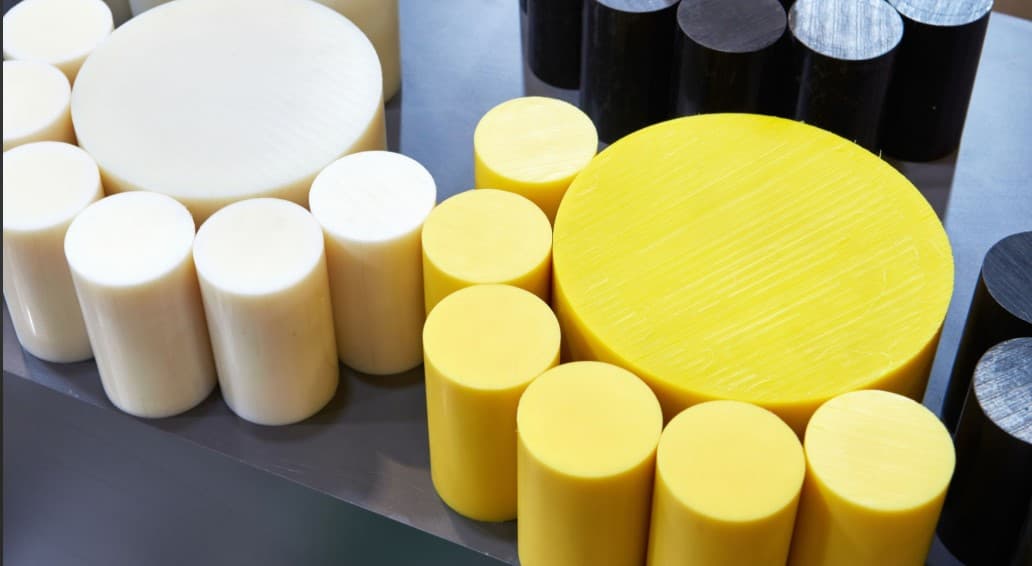
This guide is for maintenance managers and buyers who must choose between nylon and PTFE (Teflon). It sets out what our catalogue lists for each, so you can see what to tell us. Tell us the job before you pick one, because the two materials are listed for different uses.
What our catalogue lists for each material
Our industrial materials range includes both materials, as rod and as sheet. The catalogue wording is short, so here it is as written.
- Nylon rod and sheet: strong engineering plastic profiles suitable for machining, rollers, spacers and wear parts.
- Teflon (PTFE) rod and sheet: low-friction PTFE material for chemical resistance, insulation, guide parts and machine components.
The catalogue does not compare the two. It gives no table of figures for either one, so we do not add numbers here. The right choice depends on what your part does, and we confirm it with you.
Our catalogue names the product Teflon rod and sheet and describes the material as PTFE. Use either name in your enquiry.
Nylon: rollers, spacers and wear parts
Our catalogue lists nylon for rollers, spacers and wear parts. It also lists it as suitable for machining. If your part is one of these, tell us and we will confirm.
A roller turns against something. A spacer holds two parts apart. A wear part is the piece you expect to replace when it wears. Tell us which one you have and what it touches.
If you machine the part yourself, tell us the finished size. Then we can confirm a rod or sheet size with enough material for it. Our guide to nylon rod for rollers and spacers goes deeper on that use.
PTFE (Teflon): chemical areas, guide parts and insulation
Our catalogue lists PTFE for chemical resistance, insulation, guide parts and machine components. Your part may sit in a chemical area, or guide something that slides past it. Tell us, and we will confirm if PTFE is the material to quote.
If chemicals are involved, name each one. A general word such as "acid" or "cleaner" is not enough for us to confirm a material. Send the product name from the label.
If the part is a guide or a machine component, tell us how it moves and what it touches. The catalogue lists low friction and chemical resistance for PTFE. Your list of conditions shows whether those points matter for your job. For insulation, see our guide to PTFE gaskets and insulating parts.
When the job fits both lists
Some parts sit in the middle. A guide part can also wear. A part in a chemical area can also carry a load. The two catalogue lists do not settle these cases.
Tell us the full job and we will confirm the material. Do not choose by name alone. Our catalogue does not rank the two.
If you are changing the material on a part that already works, tell us first. A rod of the new material in the same size is not a promise that the part will behave the same. We will check the change with you before you order.
Give us the job, not only the material name
A short description of the job saves many questions. These points help most:
- What the part is: a roller, a spacer, a guide, a wear part or something else.
- Whether the part moves, and what it moves against.
- Any chemicals it touches, by product name.
- Whether it must insulate.
- The load, if you know it. Tell us what you do not know as well.
- How the old part failed, if you are replacing one.
If your drawing names the material, copy the name exactly. Do not write "plastic rod" alone. If you want help choosing, say so, and we will ask for what we need.
What to send us for a quote
- The part name and what it does in the machine or assembly.
- Nylon, PTFE (Teflon) or "help me choose".
- Rod or sheet, or both.
- Rod diameter and length, or sheet length, width and thickness, with units in millimetres.
- The quantity you need.
- Any chemicals the part touches, by product name.
- The finished size, if you will machine the part yourself.
- A photo or drawing of the old part, if there is one.
- If you need product documents, say so in the enquiry.
Request a quote on our website or message us on WhatsApp, and we will confirm the right material for your job.