
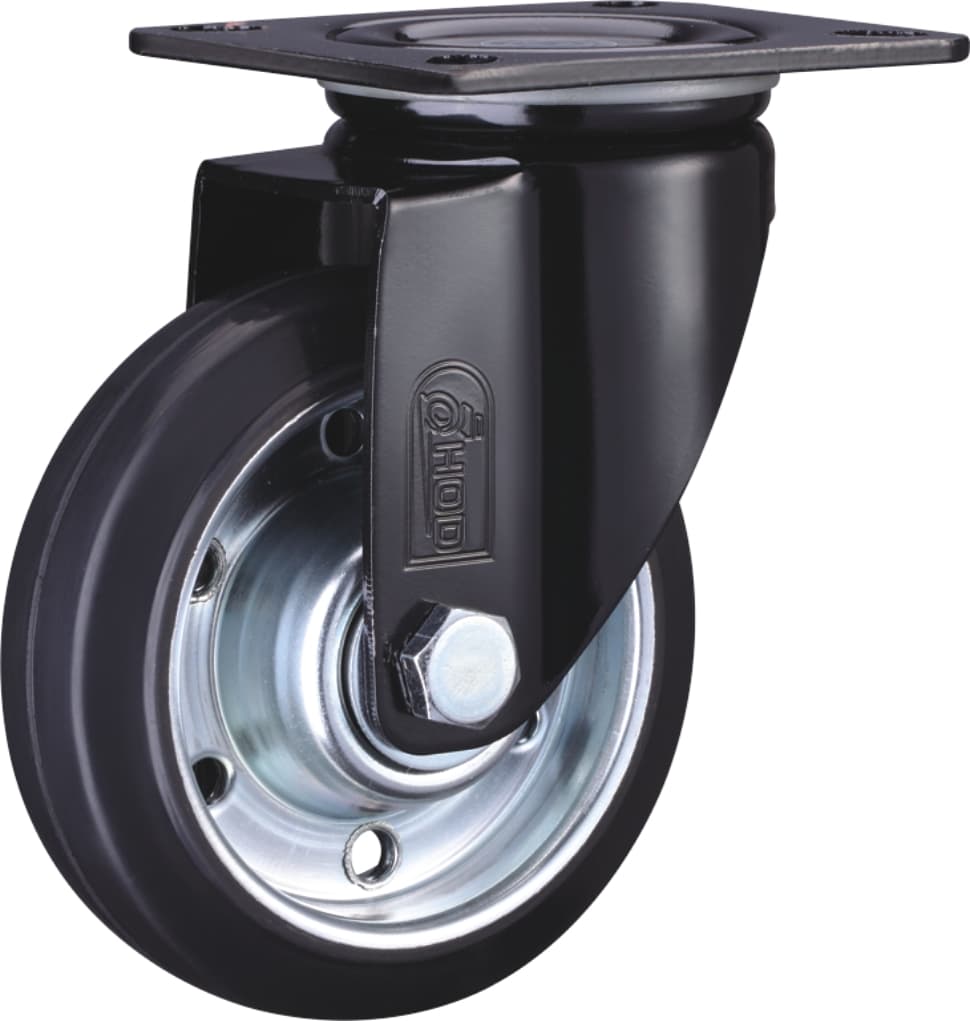
This guide is for supervisors and maintenance teams whose trolleys take too much effort to push once they carry a load. The cause can be in the casters, the floor or the way the trolley is used. Here are the checks for effort, in order.
Compare empty and loaded
Push the trolley empty, then loaded, on the same route. Note how much worse the loaded push is, and whether it is hard to start, hard to keep moving or hard to turn. Write down which of the three it is.
If the empty trolley is also stiff, check the casters and the floor. If only the loaded trolley is stiff, check the load per caster.
Check the load per caster
Weigh the loaded trolley and divide by the number of casters. Then compare the result with the listed load of your exact caster option, not the series range. Our guide to caster load capacity shows the method.
A trolley that has gained shelves, tools or goods since it was built may now carry more than its casters were chosen for. Weigh it again. Leave margin below the listed load.
Check the wheel against the floor
The wheel material and the floor work as a pair. Our catalogue names wheel materials such as PU, PA, ER and TPR, and each series lists its own. It gives no rolling-effort figure for any of them, so we cannot call one wheel easy to push.
Tell us what the floor is: smooth concrete, rough concrete, tile, metal plate or an outdoor yard. Tell us about joints, thresholds and ramps on the route too. Tell us the floor and the load, and we will confirm the options to quote.
Look at the casters and the bearing
Check each wheel by hand, following your site's safety rules. Compare the casters with each other. The odd one out is where to start.
- A wheel with a flat spot or uneven wear.
- A wheel that turns stiffly or drags, which can mean a worn or dirty bearing.
- A swivel that sticks, grinds or has play in it.
- A brake that rubs on the wheel.
- Casters of mixed series or wheel materials on one frame.
Our catalogue names the bearing in each series: single bearing, double bearing, Delrin bearing and a few others. It does not say how easily any of them rolls. So a bearing name alone will not tell you why a trolley is stiff. If your old caster has a bearing name on it, send it to us. Our guide to single, double and Delrin bearing casters shows how each series names it.
For the full routine check, use our caster wheel maintenance checklist. For noise and for shimmy, see how to stop noisy caster wheels and why caster wheels wobble and shimmy.
Check the layout and the load
A trolley with all four casters swivel steers easily but can wander. One with a rigid pair tracks straight but needs more effort to turn. Our guide to swivel and rigid casters covers the layouts.
If the load is above what your casters list, send us the loaded weight and we will confirm the series. You can also use the caster finder. Our medium / heavy duty series is the HOD 62 range, with seven wheel options.
What to send us for a quote
- What the trolley is, what it carries and its loaded weight.
- The number of casters, and how many are swivel and rigid.
- When it is hard: starting, moving or turning, and empty or loaded.
- The floor and the route, including joints, ramps and thresholds.
- The wheel size and material you have now, if you know them.
- A photo of the old casters, or their code.
- The fitting: top plate, threaded stem, bolt hole or another fitting.
- The quantity you need.
Request a quote on our website or message us on WhatsApp, and we will confirm the right series for your trolley.