
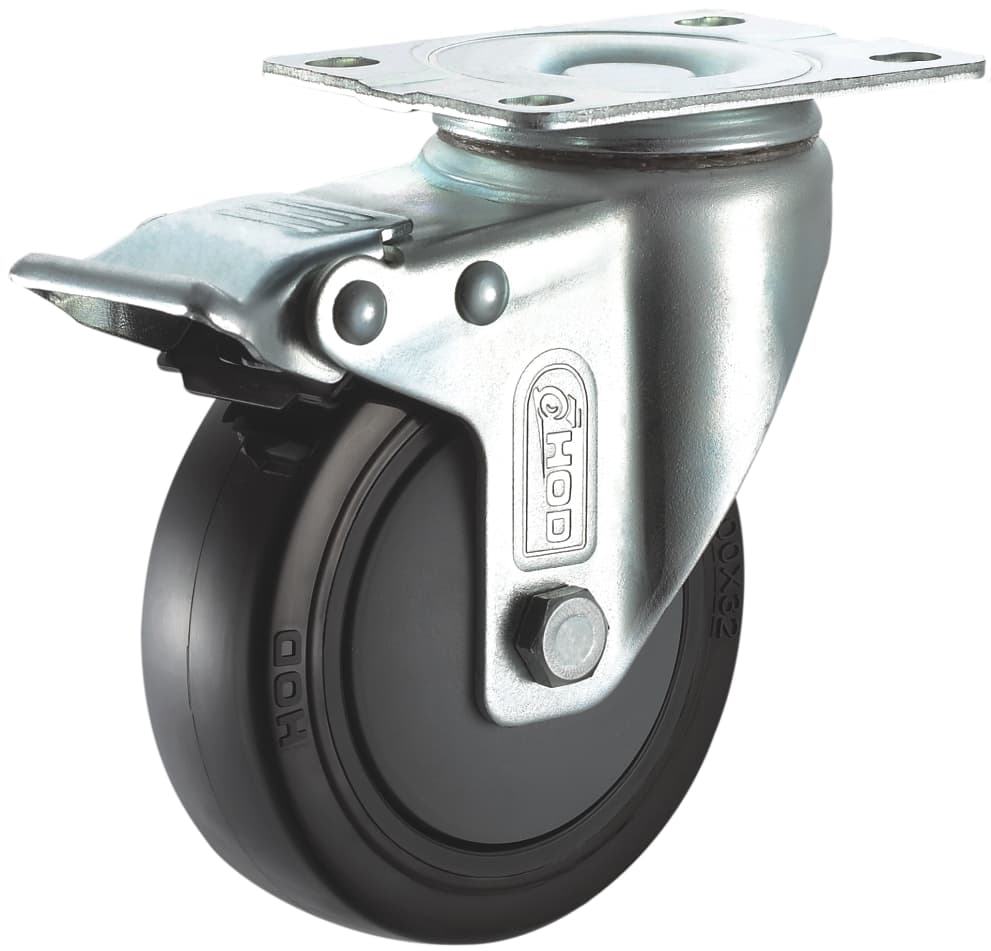
This glossary is for buyers and maintenance teams who read a caster quote or catalogue and meet a word they do not know. Each term below has one to three plain sentences. Where a topic needs more, we link to the guide that covers it.
How the caster moves and stops
- Swivel: a caster that turns, so the wheel follows the direction you push. Our guide to swivel and rigid casters shows how to mix them on a trolley.
- Rigid: a caster whose wheel only rolls straight. In our catalogue, rigid casters are listed with a top plate.
- Raceway: the track in the swivel head that lets the top turn on the body. Our catalogue does not list the raceway for each series, so ask us if it matters for your job.
- Axle: the pin the wheel turns on. Thread or wrap caught round the axle can make a wheel drag.
- Brake: a lock on a caster that holds the wheel, the swivel or both. Not every caster has one.
- Brake type: our catalogue gives each type a name, such as Side Lock Brake (Metal). Rigid casters are listed as Non Lock Brake (Rigid).
Our guide to caster brakes explained for buyers gives all the brake names as printed. Tell us which casters on your trolley need a brake.
How the caster attaches
Our catalogue names four ways a caster attaches: top plate, threaded stem, bolt hole and other fitting. The guide to top plate, threaded stem and bolt hole casters defines each one and shows how to find yours.
For what to measure on an old caster, see replacement caster measurements.
The wheel and the bearing
- Tread: the outer layer of the wheel, the part that touches the floor.
- Wheel core: the centre of the wheel under the tread. Some catalogue names say it, such as Iron Core PU.
- Wheel material: the material of the tread. Our catalogue names materials by short codes such as PU, PA, ER and TPR, and we use them as printed. Our guide to wheel materials in our catalogue lists them by series.
- Bearing: the part inside the wheel that lets it turn on the axle. The catalogue names it single bearing, double bearing, Delrin bearing and a few other ways. We do not expand these names here.
The medium duty series lists single bearing and double bearing models. See single, double and Delrin bearing casters for how each series names its bearing.
Load and series words
- Load rating: the load our catalogue lists for one caster, not for the whole trolley. It can change with the wheel material, so read it on the exact option.
- Loaded weight: the empty trolley plus the heaviest load it will carry. The caster load capacity guide shows how to turn this into a load per caster.
- Series: one family of casters in the catalogue, for example heavy duty. Each series has its own page, models and wheel options.
- Duty class: the names light, medium and heavy duty. They are catalogue labels, and the ranges overlap. See the difference between the duty classes.
Codes and names on a quote
- Model code: the full code of one caster option. Send it exactly as printed. Do not read a meaning into single digits, because we confirm each code from the product documents.
- HOD series code: the short code HOD gives some series, such as 62 or A1, where the series page shows one.
- A vague line: a quote line that says only "heavy duty caster" is not enough to order from. It needs the series, the wheel and the fitting.
If you can, use our caster finder, which filters models by mounting, brake, wheel material and load.
What to send us for a quote
- What the trolley or equipment is, and what it carries.
- The loaded weight and the number of casters.
- The words you do not understand, copied from your quote or old paperwork.
- A photo of the old caster, and its code if you can read it.
- The fitting: top plate, threaded stem, bolt hole or another fitting.
- Rigid, swivel or brake, and how many of each.
- The floor, and anything on it such as water or oil.
- The quantity you need.
Request a quote on our website or message us on WhatsApp, and we will confirm the right series and codes for your trolley.